
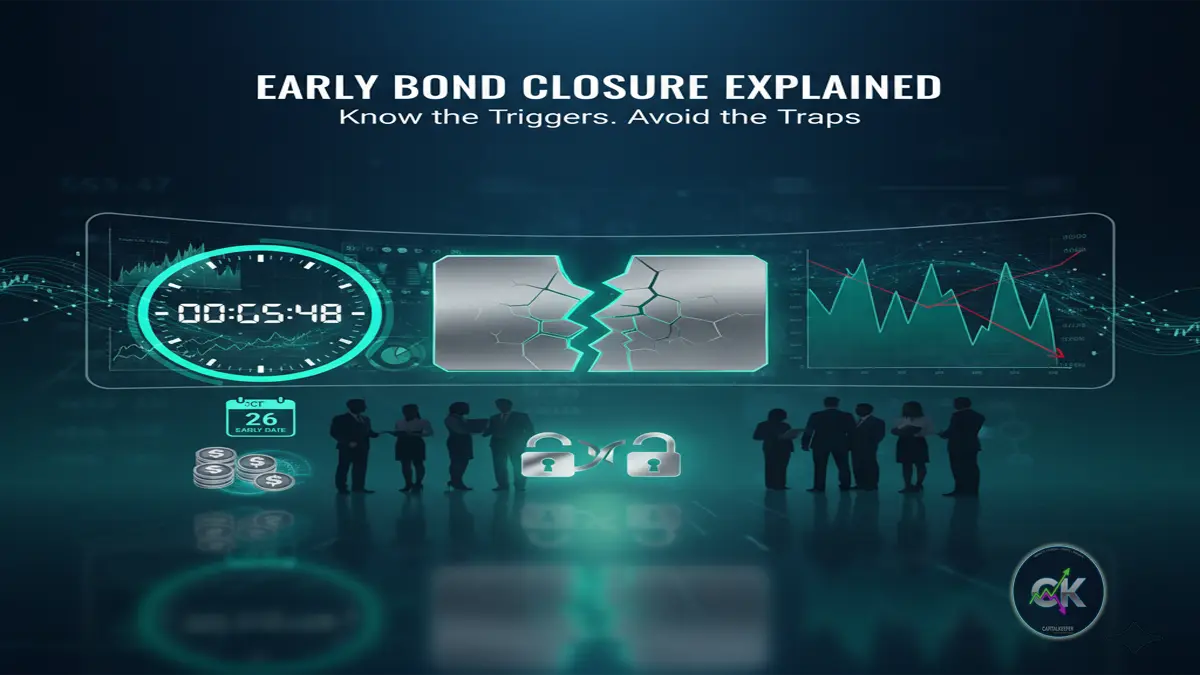
Understanding Early Closure in Bonds (2025) | Causes, Impact & Investor Strategy
By CapitalKeeper | Corporate Bond | Indian Equities | Market Moves That Matter
Learn why early closure happens in bonds, what it means for retail investors, and how to plan your debt investments wisely. A complete 2025 guide to fixed-income opportunities and strategies.
📘 Introduction: Why Early Closure in Bonds Matters More in 2025
Bonds have become a major focus for Indian investors in 2025. With the Reserve Bank of India (RBI) maintaining a data-driven rate stance and India’s inclusion in the JP Morgan Emerging Market Bond Index, the fixed-income market is buzzing with new issues and retail participation.
But there’s one recurring headline you may have seen —
“XYZ Bond Issue Closes Early Due to Overwhelming Response.”
If you’ve ever missed out on such opportunities, you’re not alone.
Let’s break down what early closure in bonds means, why it happens, and how to make sure you’re prepared next time.
💡 What Is Early Closure in Bonds?
Early closure refers to when an issuer — whether a corporate, PSU, or municipal body — decides to end the subscription window before the scheduled closing date due to oversubscription or fulfillment of the fundraising target.
For example:
If a company planned to raise ₹500 crore through its bond issue over 7 days but receives ₹500 crore worth of bids within 2 days, it can announce early closure on the 3rd day itself.
In simpler terms:
Early closure = Investor demand > Supply of bonds.
📊 Why Do Bond Issues Close Early?
Here are the main reasons driving early closure trends in 2025:
1️⃣ Strong Investor Demand for Safe Yields
With equity markets witnessing volatility around global interest rate uncertainty, investors are turning to debt instruments for stable returns.
When a AAA-rated issuer offers a 9%–10% annual yield, it’s natural for investors to rush in quickly — leading to early closure.
2️⃣ Limited Issue Size
Corporate bond issuers often keep a fixed corpus target. Once the quota is filled, there’s no regulatory reason to continue the issue window. Hence, smaller issue sizes get subscribed much faster.
3️⃣ Attractive Interest Rates Compared to FDs
When bond coupon rates are 1–2% higher than large bank FDs or small savings schemes, demand spikes.
In 2025, with 3-year bonds offering 8.75%–9.25% and FDs averaging 6.5%, investors clearly prefer bonds.
4️⃣ Institutional Rush
Institutional and HNI investors often subscribe in bulk during the first few hours of bond issuance, leaving little room for retail investors if they act late.
5️⃣ Market Sentiment & Branding
Brands like NHAI, REC, IRFC, or Tata Capital often enjoy high trust. Investors don’t think twice before subscribing — making early closures common.
⚙️ How Early Closure Impacts Retail Investors
While early closure sounds positive for issuers, retail investors face a few challenges:
- ❌ Missed Allocation: Late applicants may get zero allotment.
- 📉 Reduced Diversification: Missing a good bond issue means losing out on a high-quality fixed-income option.
- ⏳ Capital Idle Period: Funds kept aside for subscription remain unused until the refund or next issue.
- 💸 Missed Yield Opportunity: Some investors miss locking in attractive interest rates before yields fall in subsequent issues.
📈 Recent Trends in 2025: Bond Demand Is Outpacing Supply
According to recent data from the National Stock Exchange (NSE) and BSE bond platforms:
- Retail participation in bond issues has tripled since 2022.
- PSU bonds like REC, PFC, and IRFC got fully subscribed within 24 hours of launch.
- Private issuers such as Edelweiss Financial Services and Muthoot Finance have also seen record oversubscriptions.
This clearly shows — investors now see bonds as mainstream investment vehicles, not just a conservative alternative.
🧭 How to Avoid Missing Out on Early Closures
Here’s your step-by-step strategy to ensure you never miss another bond opportunity:
✅ 1. Stay Updated via SEBI-Approved Platforms
Keep an eye on:
- NSE/BSE EBP Portals
- Online investment platforms like GoldenPi, BondsIndia, and IndiaBonds
- Company announcements and press releases
Subscribe to email alerts for new issues to get real-time updates.
✅ 2. Apply Early on Day 1
Most early closures happen within the first 24–48 hours. Submitting your application on Day 1 itself increases your chances of allotment significantly.
✅ 3. Track Institutional Bookings
Once QIB (Qualified Institutional Buyers) and HNI quotas start filling rapidly, retail closure usually follows. Monitor subscription status online for clues.
✅ 4. Diversify Issue Types
Instead of waiting for one “perfect” bond, create a laddered portfolio — mix of AAA, AA-rated and different tenures.
That way, even if one issue closes early, you still have other options.
✅ 5. Keep Liquidity Ready
Avoid the trap of transferring funds at the last moment.
Keep a dedicated corpus in your trading or bank account ready for subscription.
📉 Should You Chase Every Early Closing Bond?
Not necessarily.
Sometimes, early closure creates a fear of missing out (FOMO) — but that doesn’t mean every bond is worth buying.
Here’s how to evaluate quickly before applying:
| Factor | What to Check | Why It Matters |
|---|---|---|
| Credit Rating | AAA, AA+ preferred | Ensures capital safety |
| Coupon Rate | Compare with FD & inflation | Real return indicator |
| Issuer Profile | PSU vs Private | Stability & repayment confidence |
| Tenure | Short, Medium, Long | Matches your financial goals |
| Taxation | Interest taxable as income | Affects post-tax yield |
🧮 Example: Comparing Two 2025 Issues
| Bond Name | Coupon Rate | Tenure | Rating | Early Closure? | Comments |
|---|---|---|---|---|---|
| REC PSU Bonds | 8.90% | 10 years | AAA | Closed on Day 2 | Strong demand, high safety |
| Private NBFC Bonds | 10.25% | 3 years | AA | Open for full week | Higher risk-return play |
This comparison shows how investors balance between yield and safety, and why early closures usually happen for trusted, lower-risk issuers.
🏁 Final Thoughts: Be Prepared, Not Reactive
Early closure in bonds isn’t a problem — it’s a signal of rising financial literacy and stronger participation in India’s debt market.
But the key is timing and awareness.
If you’re proactive, track issues regularly, and plan ahead, you can easily stay ahead of the crowd.
In 2025 and beyond, as India’s bond market continues to deepen, understanding such nuances will give you an edge over traditional investors still chasing only equities.
📌 For daily trade setups, technical learning, and smart investing tips, stay tuned to CapitalKeeper.in
📌 For more real-time updates, trade setups, and investment insights — follow us on [Telegram] and [WhatsApp Channel] subscribe to our newsletter!

Subscribe Now , Join Telegram the Crypto Capital Club, Get Free Crypto Updates
📌 Disclaimer
The content provided on CapitalKeeper.in is for informational and educational purposes only and does not constitute investment, trading, or financial advice. While we strive to present accurate and up-to-date market data and analysis, we make no warranties or representations regarding the completeness, reliability, or accuracy of the information.
Stock market investments are subject to market risks, and readers/investors are advised to conduct their own due diligence or consult a SEBI-registered financial advisor before making any investment decisions. CapitalKeeper and its authors are not liable for any loss or damage, direct or indirect, arising from the use of this information.
All views and opinions expressed are personal and do not reflect the official policy or position of any agency or organization. Past performance is not indicative of future results.By using this website, you agree to the terms of this disclaimer.
Ranjit Sahoo
Founder & Chief Editor – CapitalKeeper.in
Ranjit Sahoo is the visionary behind CapitalKeeper.in, a leading platform for real-time market insights, technical analysis, and investment strategies. With a strong focus on Nifty, Bank Nifty, sector trends, and commodities, she delivers in-depth research that helps traders and investors make informed decisions.
Passionate about financial literacy, Ranjit blends technical precision with market storytelling, ensuring even complex concepts are accessible to readers of all levels. Her work covers pre-market analysis, intraday strategies, thematic investing, and long-term portfolio trends.
When he’s not decoding charts, Ranjit enjoys exploring coastal getaways and keeping an eye on emerging business themes.
📌 Follow Ranjit on:
LinkedIn | Twitter/X | Instagram | ✉️ contact@capitalkeeper.in






Leave a Reply