


Personal Care & Home Hygiene FMCG Growth 2025 — HUL, Godrej, Marico, Dabur in Focus
By CapitalKeeper | Pre Market Opening | Indian Equities | Market Moves That Matter
Day 2 — Personal Care & Home Hygiene Giants: Beyond Tier-1, Into Every Home
Series: FMCG + Rural Consumption | CapitalKeeper
Introduction — The hygiene & grooming boom
For decades, personal care and home hygiene were treated as “non-discretionary basics” in Indian consumption. Soap, toothpaste, hair oil, floor cleaners — they were staples with slow but steady volume growth. But in the last 10 years, this segment has transformed into a vibrant growth engine, powered by three trends:
- Urban premiumisation — consumers trading up to higher-margin products.
- Rural sachet revolution — making branded hygiene affordable to low-income households.
- Digital commerce acceleration — from e-commerce giants to quick-commerce 10-minute deliveries.
These trends are now converging, creating a massive runway for personal care and hygiene brands to grow both deep (penetration) and wide (product range). For investors, the sector offers a rare mix of volume stability, pricing power, and long-term category expansion.
The structural drivers at play
1. Premiumisation in urban India
Middle-class urban households are upgrading to specialized shampoos, anti-pollution face washes, herbal toothpaste, and premium home cleaners. This shift is driven by:
- Higher disposable incomes.
- Rising awareness of global brands via social media.
- Willingness to pay for quality and brand image.
For companies, premium SKUs are margin accretive — smaller volumes, higher profits.
2. Affordable sachet strategy for rural penetration
Sachet economics has been a game-changer for rural India. From ₹1 shampoos to ₹5 detergent packs, sachets give consumers a low entry price point while delivering branded experience. The repeat-purchase cycle builds habit, often leading to larger pack adoption over time.
Companies like HUL, Godrej Consumer, Dabur and Marico have refined rural distribution networks to deliver these SKUs efficiently, even in low-population-density areas.
3. E-commerce & quick commerce as growth multipliers
While e-commerce penetration in FMCG is still single-digit nationally, it’s growing fast in urban India. Platforms like Amazon, Flipkart, Blinkit, Zepto and BigBasket are pushing personal care products with aggressive offers.
Quick commerce is particularly powerful for high-frequency home hygiene products like detergents, floor cleaners, and dishwash liquids — where convenience drives incremental purchases.
Company snapshots — who’s leading the charge
Hindustan Unilever (HUL) — the category king
HUL commands a dominant position across soap, detergent, hair care, and skincare. Its strengths:
- Multi-tier portfolio: From mass brands like Lifebuoy and Wheel to premium lines like Dove and Surf Excel Matic.
- Distribution depth: ~9 million retail outlets covered.
- Product innovation: New launches in herbal and plant-based categories to capture the health-conscious segment.
Investor watch: Volume growth in rural categories, premium portfolio margin expansion, and e-commerce contribution rising above 10%.
Godrej Consumer Products — emerging markets specialist
Godrej Consumer combines strong India brands with Africa, Indonesia, and Latin America exposure. In India, its key segments are hair colour, household insecticides, and soaps.
- Rural strategy: affordable variants of Godrej Expert Rich Crème hair colour and Good Knight mosquito repellents.
- Innovation: Launch of natural and low-chemical household cleaners.
Investor watch: Sustained volume recovery in India + margin expansion from commodity cost easing.
Marico — brand trust in hair & edible oils, expanding into hygiene
Marico is best known for Parachute hair oil and Saffola edible oil, but it has been expanding into premium personal care and wellness.
- Premiumisation: Saffola Honey, Saffola ImmuniVeda range.
- Rural play: Low-price Parachute packs and Nihar Naturals for hair care.
- D2C push: Acquisitions in digital-first brands like Beardo for men’s grooming.
Investor watch: Growth in new categories beyond core oils, especially in men’s grooming and skincare.
Dabur India — herbal heritage meets modern reach
Dabur’s strength lies in Ayurveda and herbal positioning, which resonates across income segments.
- Core categories: Oral care (Dabur Red), hair oils (Amla), health supplements (Chyawanprash), home hygiene (Sanitize).
- Rural penetration: Long experience in rural brand building through herbal trust factor.
- Urban premium play: Dabur Herb’l toothpaste, Real Activ juices.
Investor watch: How herbal personal care competes with chemical-based multinationals in premium urban segments.
How rural & urban demand cycles differ
- Urban markets are driving premium margins — think ₹300 face serums, high-end hair masks, robotic mop-friendly cleaners.
- Rural markets are driving absolute volume growth — sachets, ₹10 toothpaste packs, multipurpose cleaners.
Companies winning both games will show strong blended revenue and margin growth.
E-commerce and omnichannel — the hidden growth engine
Digital channels are more than just a sales platform. They offer:
- Rapid consumer feedback: New SKUs tested online before national rollout.
- Dynamic pricing: Quick response to competitor discounting.
- Cross-selling: Bundling hygiene with personal care in online carts.
For investors, brands that successfully integrate e-commerce and offline retail will achieve faster category expansion.
Export & adjacent category opportunities
While personal care exports are still small for most Indian FMCG players, they’re rising, especially in Southeast Asia, Middle East, and Africa. Products like herbal toothpaste, ayurvedic hair oil, and low-cost detergents are finding markets in diaspora and emerging economies.
Day 2 — Personal Care & Home Hygiene Giants: Beyond Tier-1, Into Every Home
Series: FMCG + Rural Consumption | CapitalKeeper
Introduction — The hygiene & grooming boom
For decades, personal care and home hygiene were treated as “non-discretionary basics” in Indian consumption. Soap, toothpaste, hair oil, floor cleaners — they were staples with slow but steady volume growth. But in the last 10 years, this segment has transformed into a vibrant growth engine, powered by three trends:
- Urban premiumisation — consumers trading up to higher-margin products.
- Rural sachet revolution — making branded hygiene affordable to low-income households.
- Digital commerce acceleration — from e-commerce giants to quick-commerce 10-minute deliveries.
These trends are now converging, creating a massive runway for personal care and hygiene brands to grow both deep (penetration) and wide (product range). For investors, the sector offers a rare mix of volume stability, pricing power, and long-term category expansion.
The structural drivers at play
1. Premiumisation in urban India
Middle-class urban households are upgrading to specialized shampoos, anti-pollution face washes, herbal toothpaste, and premium home cleaners. This shift is driven by:
- Higher disposable incomes.
- Rising awareness of global brands via social media.
- Willingness to pay for quality and brand image.
For companies, premium SKUs are margin accretive — smaller volumes, higher profits.
2. Affordable sachet strategy for rural penetration
Sachet economics has been a game-changer for rural India. From ₹1 shampoos to ₹5 detergent packs, sachets give consumers a low entry price point while delivering branded experience. The repeat-purchase cycle builds habit, often leading to larger pack adoption over time.
Companies like HUL, Godrej Consumer, Dabur and Marico have refined rural distribution networks to deliver these SKUs efficiently, even in low-population-density areas.
3. E-commerce & quick commerce as growth multipliers
While e-commerce penetration in FMCG is still single-digit nationally, it’s growing fast in urban India. Platforms like Amazon, Flipkart, Blinkit, Zepto and BigBasket are pushing personal care products with aggressive offers.
Quick commerce is particularly powerful for high-frequency home hygiene products like detergents, floor cleaners, and dishwash liquids — where convenience drives incremental purchases.
Company snapshots — who’s leading the charge
Hindustan Unilever (HUL) — the category king
HUL commands a dominant position across soap, detergent, hair care, and skincare. Its strengths:
- Multi-tier portfolio: From mass brands like Lifebuoy and Wheel to premium lines like Dove and Surf Excel Matic.
- Distribution depth: ~9 million retail outlets covered.
- Product innovation: New launches in herbal and plant-based categories to capture the health-conscious segment.
Investor watch: Volume growth in rural categories, premium portfolio margin expansion, and e-commerce contribution rising above 10%.
Godrej Consumer Products — emerging markets specialist
Godrej Consumer combines strong India brands with Africa, Indonesia, and Latin America exposure. In India, its key segments are hair colour, household insecticides, and soaps.
- Rural strategy: affordable variants of Godrej Expert Rich Crème hair colour and Good Knight mosquito repellents.
- Innovation: Launch of natural and low-chemical household cleaners.
Investor watch: Sustained volume recovery in India + margin expansion from commodity cost easing.
Marico — brand trust in hair & edible oils, expanding into hygiene
Marico is best known for Parachute hair oil and Saffola edible oil, but it has been expanding into premium personal care and wellness.
- Premiumisation: Saffola Honey, Saffola ImmuniVeda range.
- Rural play: Low-price Parachute packs and Nihar Naturals for hair care.
- D2C push: Acquisitions in digital-first brands like Beardo for men’s grooming.
Investor watch: Growth in new categories beyond core oils, especially in men’s grooming and skincare.
Dabur India — herbal heritage meets modern reach
Dabur’s strength lies in Ayurveda and herbal positioning, which resonates across income segments.
- Core categories: Oral care (Dabur Red), hair oils (Amla), health supplements (Chyawanprash), home hygiene (Sanitize).
- Rural penetration: Long experience in rural brand building through herbal trust factor.
- Urban premium play: Dabur Herb’l toothpaste, Real Activ juices.
Investor watch: How herbal personal care competes with chemical-based multinationals in premium urban segments.
How rural & urban demand cycles differ
- Urban markets are driving premium margins — think ₹300 face serums, high-end hair masks, robotic mop-friendly cleaners.
- Rural markets are driving absolute volume growth — sachets, ₹10 toothpaste packs, multipurpose cleaners.
Companies winning both games will show strong blended revenue and margin growth.
E-commerce and omnichannel — the hidden growth engine
Digital channels are more than just a sales platform. They offer:
- Rapid consumer feedback: New SKUs tested online before national rollout.
- Dynamic pricing: Quick response to competitor discounting.
- Cross-selling: Bundling hygiene with personal care in online carts.
For investors, brands that successfully integrate e-commerce and offline retail will achieve faster category expansion.
Export & adjacent category opportunities
While personal care exports are still small for most Indian FMCG players, they’re rising, especially in Southeast Asia, Middle East, and Africa. Products like herbal toothpaste, ayurvedic hair oil, and low-cost detergents are finding markets in diaspora and emerging economies.
Hindustan Unilever (HUL)
- Bullish Technical Setup
A recent analysis recommends a Buy Zone of ₹2,540–2,542, with a short-term target of ₹2,640+ and stop-loss below ₹2,490. - Analyst 12-Month Average Target
Analysts project an average target of ₹2,785, implying an upside of 11–12% from current levels.
Several brokerages, including Goldman Sachs and Jefferies, have raised price targets up to ₹2,900 subsequent to HUL’s strong Q1 FY26 results. - Suggested Technical Strategy:
- Buy Zone: ₹2,540–2,542
- Target Range: ₹2,600 – ₹2,900 (based on breakout strength and broker projections)
- Stop-Loss: Below ₹2,490
Godrej Consumer Products (GCPL) (Note: Mentioned instead of Marico due to data availability)
- Current Technical Signal
MarketScreener flags a neutral to sell bias, with no strong buy indicators across oscillators or moving averages. - Fundamentals & Outlook
The MD expects a sector turnaround in 12–18 months, supported by easing food inflation, normal monsoon, and post-pay commission demand boost. - Approach:
Given the neutral technical outlook, consider waiting for strength confirmation — such as RSI rising above 50 or MACD turning positive — before entering. - Suggested Technical Strategy:
- Buy Zone: ₹1,200–1,220
- Target Range: ₹1,600 – ₹1,900 (based on breakout strength and broker projections)
- Stop-Loss: Below ₹1,000
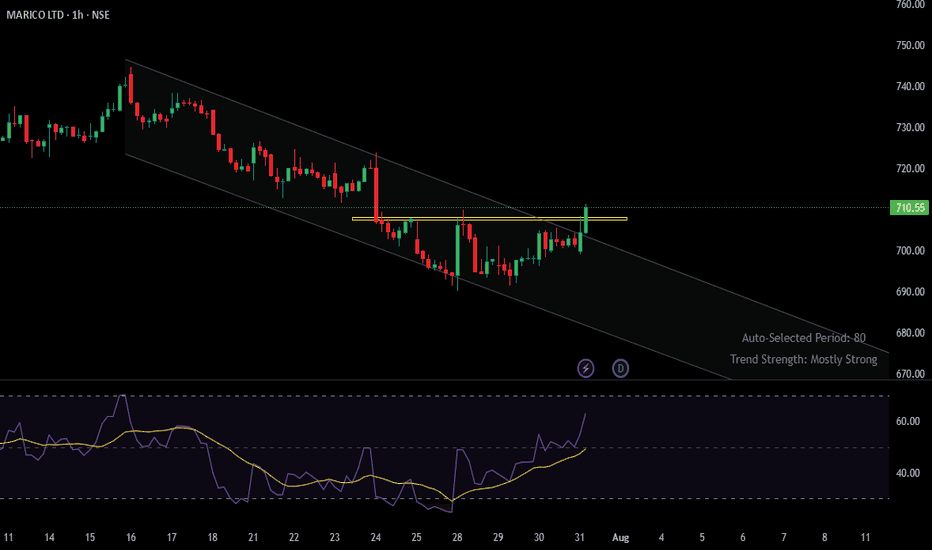
Marico

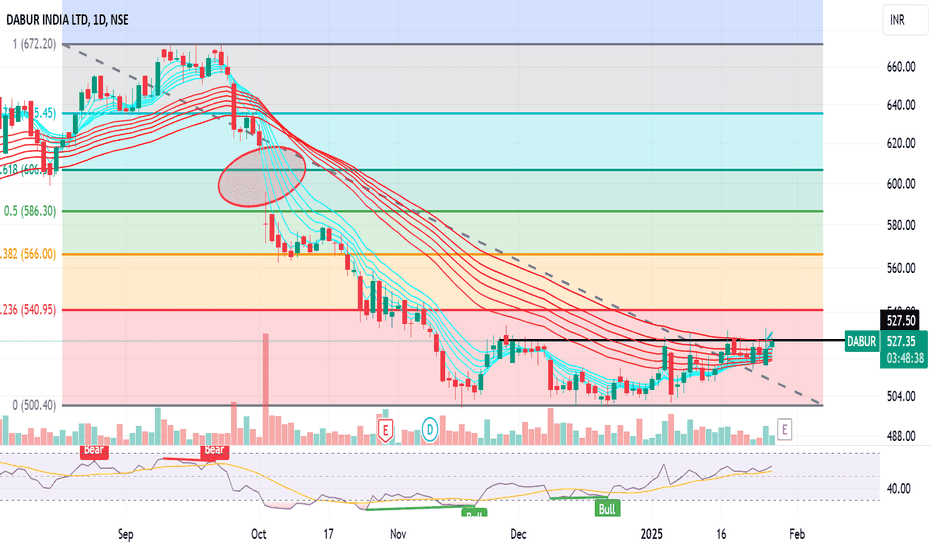
Dabur India
Marico – Technical Outlook
TradingView Insights:
- A bullish breakout observed from a descending channel or flag formation.
- Suggested entry at ₹708–₹710 on support retest or breakout confirmation;
- Stop-loss: conservative at ₹700 or aggressive at ₹698.
- Target 1: ₹720–₹725
- Target 2: ₹745–₹750
Alternate Strategy:
- Add on breakout above ₹715, with SL below ₹678.
- Targets: ₹729–₹740, and extended to ₹810 for longer-term holders.
Summary – Marico
- Buy Zone: ₹708–₹715 (support retest or breakout)
- Target Range: ₹725 → ₹780
- Stop-Loss: ₹698–₹700
Dabur India – Technical Outlook
Economic Times Technicals:
- A breakout above the falling trendline with volume lift.
- Target: ₹555
- Stop-Loss: ₹504
TradingView/Zonal Setup:
- Retracement setup suggests a move to ₹650–₹700 if it sustains above ₹600.
- Stop-Loss: below ₹580
Support-Based Entry:
- Source indicates a demand zone in ₹480–₹500, with resistance at ₹540–₹560.
Summary – Dabur India
- Buy Zone: ₹600+ (on breakout), or ₹480–₹500 (on base support strategy)
- Target Range: ₹555 (breakout) → ₹650–₹700 (on strong continuation)
- Stop-Loss: ₹504 (breakout), or ₹580 (on higher entry)
How investors should approach the theme
- Core holdings: HUL for category leadership and portfolio breadth; Dabur for herbal positioning.
- High-beta plays: Godrej Consumer for turnaround and Africa play; Marico for men’s grooming and premium wellness expansion.
- E-commerce leverage: Track % of sales from digital channels; above 10% and rising is a strong signal.
- Monitor rural volume growth: A leading indicator for the next 2–3 years’ earnings trajectory.
- Look for premium SKU contribution growth: Shows urban consumers are trading up despite inflation.
Risks & headwinds
- Commodity inflation in palm oil, packaging materials, and chemicals can squeeze margins.
- Intense competition from regional brands offering similar quality at lower price points.
- Slowdown in rural incomes due to monsoon failure or agri distress can affect volume recovery.
- Channel conflict between traditional retail and quick commerce, impacting margins.
How investors should approach the theme
- Core holdings: HUL for category leadership and portfolio breadth; Dabur for herbal positioning.
- High-beta plays: Godrej Consumer for turnaround and Africa play; Marico for men’s grooming and premium wellness expansion.
- E-commerce leverage: Track % of sales from digital channels; above 10% and rising is a strong signal.
- Monitor rural volume growth: A leading indicator for the next 2–3 years’ earnings trajectory.
- Look for premium SKU contribution growth: Shows urban consumers are trading up despite inflation.
CapitalKeeper closing view
India’s personal care and home hygiene sector is more than “soap and detergent” — it’s a multi-layered growth story spanning urban aspiration, rural affordability, and global expansion. The market leaders have both brand power and distribution muscle, but mid-tier players with niche strengths are also making inroads.
The sweet spot for investors? Companies that blend:
- Rural volume scale.
- Urban premium margins.
- Digital channel agility.
The next phase of FMCG growth will be written in households beyond Tier-1 — and the brands already knocking on those doors will write the earnings story of this decade.
📌 For daily trade setups, technical learning, and smart investing tips, stay tuned to CapitalKeeper.in
📌 For more real-time updates, trade setups, and investment insights — follow us on [Telegram] and [WhatsApp Channel] subscribe to our newsletter!


📌 Disclaimer
The content provided on CapitalKeeper.in is for informational and educational purposes only and does not constitute investment, trading, or financial advice. While we strive to present accurate and up-to-date market data and analysis, we make no warranties or representations regarding the completeness, reliability, or accuracy of the information.
Stock market investments are subject to market risks, and readers/investors are advised to conduct their own due diligence or consult a SEBI-registered financial advisor before making any investment decisions. CapitalKeeper and its authors are not liable for any loss or damage, direct or indirect, arising from the use of this information.
All views and opinions expressed are personal and do not reflect the official policy or position of any agency or organization. Past performance is not indicative of future results.By using this website, you agree to the terms of this disclaimer.
Ranjit Sahoo
Founder & Chief Editor – CapitalKeeper.in
Ranjit Sahoo is the visionary behind CapitalKeeper.in, a leading platform for real-time market insights, technical analysis, and investment strategies. With a strong focus on Nifty, Bank Nifty, sector trends, and commodities, she delivers in-depth research that helps traders and investors make informed decisions.
Passionate about financial literacy, Ranjit blends technical precision with market storytelling, ensuring even complex concepts are accessible to readers of all levels. Her work covers pre-market analysis, intraday strategies, thematic investing, and long-term portfolio trends.
When he’s not decoding charts, Ranjit enjoys exploring coastal getaways and keeping an eye on emerging business themes.
📌 Follow Ranjit on:
LinkedIn | Twitter/X | Instagram | ✉️ contact@capitalkeeper.in