


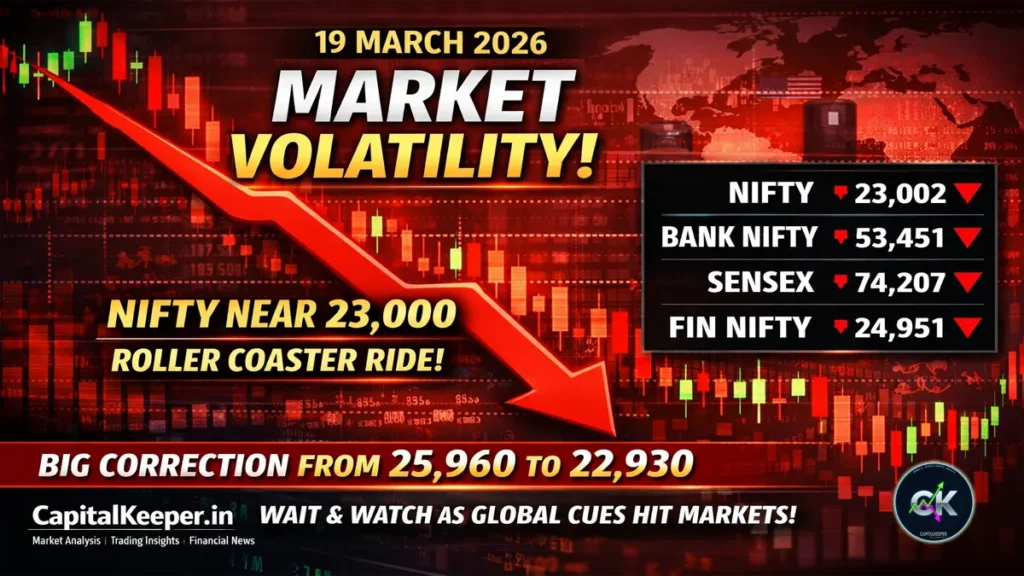
Indian Stock Market Closing Bell 19 March 2026: Nifty Slides Near 23,000 Amid High Volatility; Sensex Drops Over 500 Points
Updated: 19 March 2026
Category: Closing Bell | Market Analysis
By CapitalKeeper Research Desk
Indian stock market closing bell 19 March 2026: Nifty closes at 23,002, Sensex falls sharply and Bank Nifty remains weak. Full analysis, global cues, volatility outlook and key levels.
Indian Stock Market Closing Bell – 19 March 2026
Indian equity markets continued to remain under pressure on Thursday as benchmark indices ended lower amid persistent volatility and weak investor sentiment. The session reflected uncertainty across global markets, coupled with continued profit booking in domestic equities.
The Nifty once again drifted closer to the crucial 23,000 mark, signaling that the ongoing corrective phase is still intact. Market participants are increasingly cautious, as sharp swings and unpredictable price action dominate the current trend.
As highlighted earlier in previous analysis, the broader market has been witnessing a significant correction from the 25,900–26,000 zone, and today’s price action reinforces the view that volatility is far from over.
Market Snapshot – 19 March 2026
| Index | Open | Close | Change |
|---|---|---|---|
| Nifty 50 | 23,197.75 | 23,002.15 | -195.60 |
| Bank Nifty | 53,474.55 | 53,451.00 | -23.55 |
| Sensex | 74,750.92 | 74,207.24 | -543.68 |
| Fin Nifty | 25,148.70 | 24,951.80 | -196.90 |
The overall market tone remained bearish with intermittent pullbacks, reflecting a lack of strong buying interest.
Market Overview: Volatility Dominates Sentiment
The Indian stock market opened on a weak note, tracking mixed global cues and continued uncertainty in international markets. Although there were minor intraday recoveries, selling pressure at higher levels prevented any meaningful upside.
The trading session was marked by sharp intraday swings, highlighting the ongoing tug-of-war between buyers and sellers. However, bears maintained control as indices failed to sustain above key resistance levels.
The current market behavior clearly indicates a high-volatility phase, where both upside and downside moves are aggressive and short-lived.
Nifty Technical Analysis
The Nifty 50 closed at 23,002.15, losing nearly 200 points.
From a broader perspective, the index has corrected significantly from the 25,960 zone (shared earlier) to near 23,000 levels, confirming a strong downtrend in the short term.
Key Technical Levels
| Level | Significance |
|---|---|
| 23,400 | Immediate Resistance |
| 23,800 | Major Resistance |
| 22,930 | Immediate Support |
| 22,500 | Strong Support |
The index formed a bearish continuation pattern, indicating that selling pressure is still dominant.
Technical Insight
• Continuous lower highs and lower lows
• Weak price structure below key averages
• Resistance-based selling visible
As mentioned earlier, 22,930 is a critical level, and a breakdown below this could trigger another sharp leg of decline.
Bank Nifty: Weak but Stable
The Bank Nifty closed almost flat at 53,451.00, showing relative stability compared to broader indices.
However, this stability should not be mistaken for strength. The index is still trading under pressure and struggling to attract fresh buying.
Key Levels to Watch
| Level | Significance |
|---|---|
| 54,200 | Immediate Resistance |
| 55,000 | Major Resistance |
| 53,000 | Immediate Support |
| 52,500 | Strong Support |
A breakdown below 53,000 could accelerate selling in banking stocks.
Sensex Performance
The BSE Sensex closed at 74,207.24, falling over 500 points.
The decline reflects continued weakness in heavyweight stocks across sectors. The index is gradually moving toward key support zones, and sustained selling could push it lower.
Fin Nifty Movement
The Nifty Financial Services ended at 24,951.80, declining nearly 200 points.
Financial stocks, including NBFCs and insurance companies, saw consistent selling pressure. This indicates a broader risk-off sentiment among investors.
Sectoral Performance
Weak Sectors
The majority of sectors traded in the red:
• Banking & Financial Services
• IT Stocks
• Metal Sector
• Realty Stocks
Selling pressure remained consistent across these segments.
Defensive Stability
Some defensive pockets showed limited resilience:
• FMCG stocks
• Pharma stocks
However, the gains were marginal and insufficient to change the overall bearish tone.
Broader Market Trends
Midcap and smallcap stocks continued to remain under pressure, with many stocks witnessing sharp declines.
The broader market trend suggests:
• Reduced risk appetite
• Increased volatility
• Shift toward defensive strategies
Investors are avoiding aggressive positions and preferring to stay on the sidelines.
Global Market Cues
Global markets continue to play a crucial role in shaping domestic sentiment.
US Market Influence
US markets have been volatile due to concerns over inflation and interest rate outlook. Investors globally are cautious about monetary tightening and economic slowdown.
Asian Markets
Asian markets showed mixed to negative trends, reflecting uncertainty in global growth outlook.
Commodity and Currency Impact
Fluctuations in crude oil prices and currency volatility continue to influence market sentiment.
A stronger dollar often puts pressure on emerging markets like India, affecting capital flows.
Institutional Activity
Foreign Institutional Investors (FIIs)
FIIs continue to maintain a cautious stance and are not showing aggressive buying interest.
Domestic Institutional Investors (DIIs)
DIIs are providing some support, but their buying is not strong enough to reverse the trend.
Key Market Drivers
Today’s market movement was influenced by:
• Ongoing correction from higher levels
• Weak global cues
• Continued selling in financial stocks
• High volatility environment
These factors combined to keep markets under pressure.
Volatility Outlook: Roller Coaster Ride Continues 🎢
As already highlighted earlier, the market is currently in a high-volatility phase.
From 25,960 to near 23,000, the correction has been sharp and fast. This indicates that the market is not in a stable trend but rather in a volatile corrective structure.
👉 Expect:
• Sudden sharp upmoves
• Quick profit booking
• Fake breakouts
• High intraday swings
This is a “wait and watch” phase rather than aggressive trading.
Trading Strategy for Tomorrow
For Intraday Traders
• Trade light and avoid over-leveraging
• Watch 23,400 resistance
• Support at 22,930
For Swing Traders
• Avoid fresh longs until confirmation
• Look for reversal signals near strong support zones
For Long-Term Investors
Corrections can offer opportunities, but patience is key.
A staggered buying approach is recommended rather than lump-sum investments.
Conclusion
The Indian stock market ended lower on 19 March 2026, with Nifty hovering near the crucial 23,000 mark. The ongoing correction, combined with high volatility and weak global cues, continues to dominate market sentiment.
While occasional pullbacks may occur, the broader structure still indicates caution.
For now, the market remains a roller coaster ride, and disciplined trading with proper risk management is essential.
Internal Links for CapitalKeeper.in
- Pre-Market Analysis
- Nifty & Bank Nifty Technical Outlook
- Weekly Market Wrap
- Educational Series: RSI & MACD Explained
FAQs
Why is the Indian stock market falling?
The market is declining due to global uncertainty, profit booking, and sustained selling in financial stocks.
What is the key support level for Nifty?
The immediate support level is around 22,930, and a break below this could lead to further downside.
Is this a good time to invest?
Long-term investors can consider gradual accumulation, but should avoid aggressive buying in a volatile market.
What should traders do in this market?
Traders should focus on risk management, trade with smaller positions, and avoid overtrading.
📌 For daily trade setups, technical learning, and smart investing tips, stay tuned to CapitalKeeper.in
📌 For more real-time updates, trade setups, and investment insights — follow us on [Telegram] and [WhatsApp Channel] subscribe to our newsletter!


📌 Disclaimer
The content provided on CapitalKeeper.in is for informational and educational purposes only and does not constitute investment, trading, or financial advice. While we strive to present accurate and up-to-date market data and analysis, we make no warranties or representations regarding the completeness, reliability, or accuracy of the information.
Stock market investments are subject to market risks, and readers/investors are advised to conduct their own due diligence or consult a SEBI-registered financial advisor before making any investment decisions. CapitalKeeper and its authors are not liable for any loss or damage, direct or indirect, arising from the use of this information.
All views and opinions expressed are personal and do not reflect the official policy or position of any agency or organization. Past performance is not indicative of future results. By using this website, you agree to the terms of this disclaimer
Ranjit Sahoo
Founder & Chief Editor – CapitalKeeper.in
Ranjit Sahoo is the visionary behind CapitalKeeper.in, a leading platform for real-time market insights, technical analysis, and investment strategies. With a strong focus on Nifty, Bank Nifty, sector trends, and commodities, she delivers in-depth research that helps traders and investors make informed decisions.
Passionate about financial literacy, Ranjit blends technical precision with market storytelling, ensuring even complex concepts are accessible to readers of all levels. Her work covers pre-market analysis, intraday strategies, thematic investing, and long-term portfolio trends.
When he’s not decoding charts, Ranjit enjoys exploring coastal getaways and keeping an eye on emerging business themes.
📌 Follow Ranjit on:
LinkedIn | Twitter/X | Instagram | ✉️ contact@capitalkeeper.in