
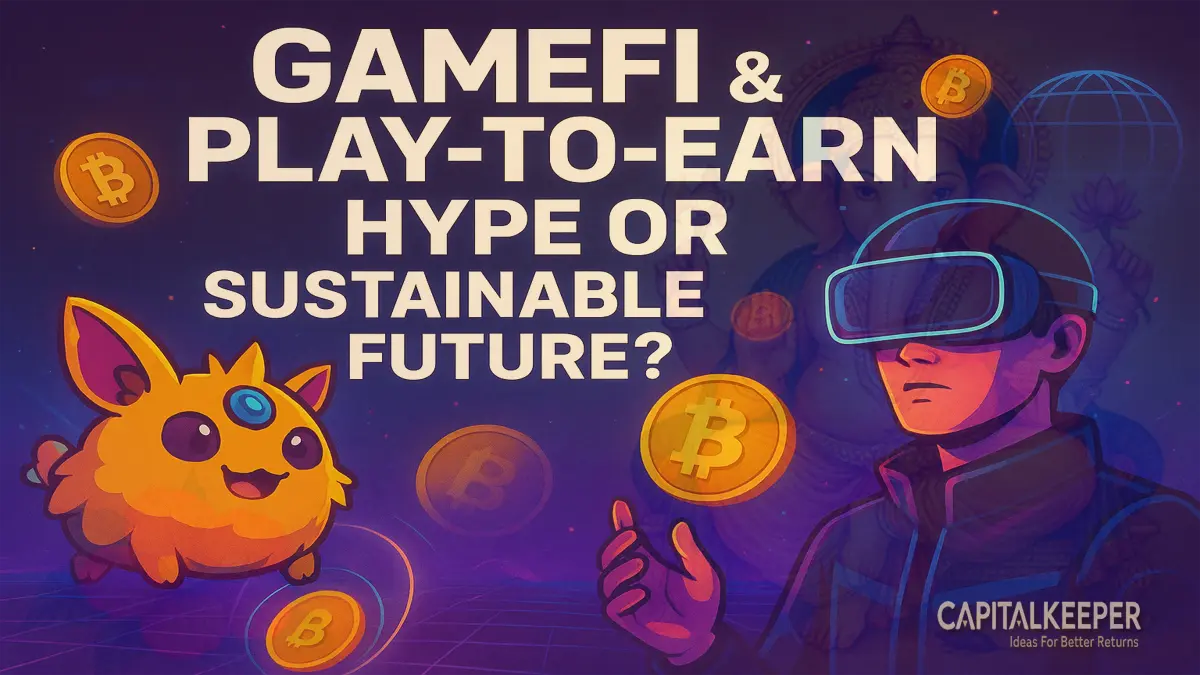
GameFi & Play-to-Earn: Hype or the Future of Gaming?
By CapitalKeeper | Crypto Defi & Web3 | Crypto Capital | Market Moves That Matter
Explore the rise of GameFi and Play-to-Earn games like Axie Infinity, Sandbox, and Decentraland. Is it hype, or can GameFi be the sustainable future of gaming?
GameFi & Play-to-Earn: Hype or Sustainable Future?
The intersection of gaming and finance has always been fascinating. From in-game purchases in the early 2000s to esports prize pools touching millions of dollars, the gaming industry has consistently evolved. The latest chapter in this evolution is GameFi—short for Gaming Finance. Fueled by blockchain, NFTs, and play-to-earn (P2E) models, GameFi promises not just entertainment but also real economic rewards for players.
But the big question remains—is GameFi just hype, or can it sustain as a long-term ecosystem? Let’s dive deep into the concept, analyze leading projects like Axie Infinity, The Sandbox, and Decentraland, and evaluate the road ahead.
What is GameFi?
GameFi refers to blockchain-based games that integrate financial incentives directly into gameplay. Unlike traditional games where spending money is the norm (buying skins, weapons, or access passes), GameFi introduces the concept of earning real-world value through gaming.
- Play-to-Earn (P2E): Gamers can earn tokens, NFTs, or digital assets by playing, which can then be traded or sold in secondary markets.
- Ownership Economy: In-game assets are NFTs, giving players true digital ownership.
- Decentralization: Players, not corporations, often govern the in-game economy through DAOs (Decentralized Autonomous Organizations).
The Hype: Why GameFi Exploded
The GameFi sector boomed in 2021–22, with billions in investments pouring in. There are several reasons for this:
- Monetization of Gameplay – For the first time, gamers could turn their time into money without being professional streamers or esports athletes.
- NFT Craze – GameFi allowed users to own characters, land, and items as NFTs, which skyrocketed in value during the NFT bull run.
- Community-Led Ecosystems – Players became investors, stakeholders, and co-builders of the ecosystem, creating a strong emotional attachment.
- Accessibility in Emerging Economies – In countries like the Philippines, India, and Vietnam, P2E games became a supplementary income source during COVID-19.
Key Projects: Case Studies
1. Axie Infinity (AXS & SLP Tokens)
- Overview: Axie Infinity was the poster child of the P2E boom. Players bred, battled, and traded “Axies” (NFT creatures) while earning Smooth Love Potion (SLP) tokens.
- Strengths: First-mover advantage, strong community, and robust NFT ecosystem.
- Challenges: The tokenomics proved unsustainable—SLP inflation caused massive price crashes, and high entry costs made the game inaccessible to new players.
2. The Sandbox (SAND Token)
- Overview: A metaverse-driven game where players can own virtual land, create experiences, and monetize through blockchain.
- Strengths: Strong partnerships (Adidas, Snoop Dogg), focus on user-generated content, and immersive 3D worlds.
- Challenges: Adoption is still limited to crypto enthusiasts; mainstream gamers remain cautious.
3. Decentraland (MANA Token)
- Overview: A decentralized virtual world where users buy land, host events, and build economies.
- Strengths: Positioned as a social and cultural hub with real-life events (concerts, exhibitions) being hosted.
- Challenges: User activity is low compared to traditional games. Land speculation has overshadowed actual gameplay.
The Sustainability Question
While GameFi has immense potential, its sustainability depends on solving some structural challenges:
- Tokenomics Issues
- Many P2E models rely on inflationary tokens that lose value as more players join.
- Without strong sinks (ways for tokens to be spent or burned), prices crash, discouraging participation.
- Player Motivation
- If players join only for financial rewards, the system becomes unsustainable. True success lies in making the game fun first, finance second.
- High Entry Barriers
- Games like Axie Infinity initially required players to spend hundreds of dollars just to start. Future GameFi projects must lower entry costs or adopt free-to-play models.
- Regulatory Uncertainty
- GameFi sits at the crossroads of gaming, finance, and gambling. Governments may impose stricter regulations on token trading, NFTs, and cross-border rewards.
- Mainstream Adoption Gap
- Traditional gamers often view NFTs and blockchain with skepticism. GameFi must prove it offers better gameplay—not just profit-making opportunities.
The Way Forward: Evolution of GameFi
For GameFi to move beyond hype and become a sustainable future, several shifts are necessary:
- Focus on Gameplay First
- The next generation of GameFi must prioritize engaging gameplay. Rewards should complement—not dominate—the experience.
- Hybrid Models
- A blend of free-to-play (F2P) and play-to-earn could work best. Let players join without upfront costs, then earn through skill and time.
- Stronger Economies
- Projects need balanced tokenomics, with proper burning mechanisms, staking, and governance to maintain long-term value.
- Integration with DeFi & Web3
- Imagine GameFi ecosystems linked with DeFi protocols where gaming rewards can be staked, borrowed against, or used across dApps.
- Bridging to Traditional Gaming
- Partnerships with established gaming studios could accelerate adoption and credibility.
Is GameFi the Future?
The answer lies somewhere between hype and potential. The early wave exposed flaws in unsustainable tokenomics but also demonstrated the massive appetite for gamer-owned economies.
- In the short term, speculative hype may continue to dominate.
- In the long term, well-designed ecosystems—where fun meets finance—could revolutionize the $200B+ gaming industry.
Projects like Axie Infinity, Sandbox, and Decentraland are just the beginning. The real winners will be those who balance entertainment, financial incentives, and sustainability.
Final Thoughts
GameFi is more than a passing trend. While early experiments faced setbacks, the idea of merging gaming with blockchain finance is too powerful to ignore. As technology matures, token models improve, and regulations stabilize, GameFi could redefine how we play, earn, and interact in digital economies.
For investors, caution is key—many projects will fail, but those that succeed could become the “next big thing” of Web3. For gamers, the dream of playing for fun and profit may finally become reality.
📌 For daily trade setups, technical learning, and smart investing tips, stay tuned to CapitalKeeper.in
📌 For more real-time updates, trade setups, and investment insights — follow us on [Telegram] and [WhatsApp Channel] subscribe to our newsletter!

Subscribe Now , Join Telegram the Crypto Capital Club, Get Free Crypto Updates
📌 Disclaimer
The content provided on CapitalKeeper.in is for informational and educational purposes only and does not constitute investment, trading, or financial advice. While we strive to present accurate and up-to-date market data and analysis, we make no warranties or representations regarding the completeness, reliability, or accuracy of the information.
Stock market investments are subject to market risks, and readers/investors are advised to conduct their own due diligence or consult a SEBI-registered financial advisor before making any investment decisions. CapitalKeeper and its authors are not liable for any loss or damage, direct or indirect, arising from the use of this information.
All views and opinions expressed are personal and do not reflect the official policy or position of any agency or organization. Past performance is not indicative of future results.By using this website, you agree to the terms of this disclaimer.
Ranjit Sahoo
Founder & Chief Editor – CapitalKeeper.in
Ranjit Sahoo is the visionary behind CapitalKeeper.in, a leading platform for real-time market insights, technical analysis, and investment strategies. With a strong focus on Nifty, Bank Nifty, sector trends, and commodities, she delivers in-depth research that helps traders and investors make informed decisions.
Passionate about financial literacy, Ranjit blends technical precision with market storytelling, ensuring even complex concepts are accessible to readers of all levels. Her work covers pre-market analysis, intraday strategies, thematic investing, and long-term portfolio trends.
When he’s not decoding charts, Ranjit enjoys exploring coastal getaways and keeping an eye on emerging business themes.
📌 Follow Ranjit on:
LinkedIn | Twitter/X | Instagram | ✉️ contact@capitalkeeper.in



Leave a Reply