
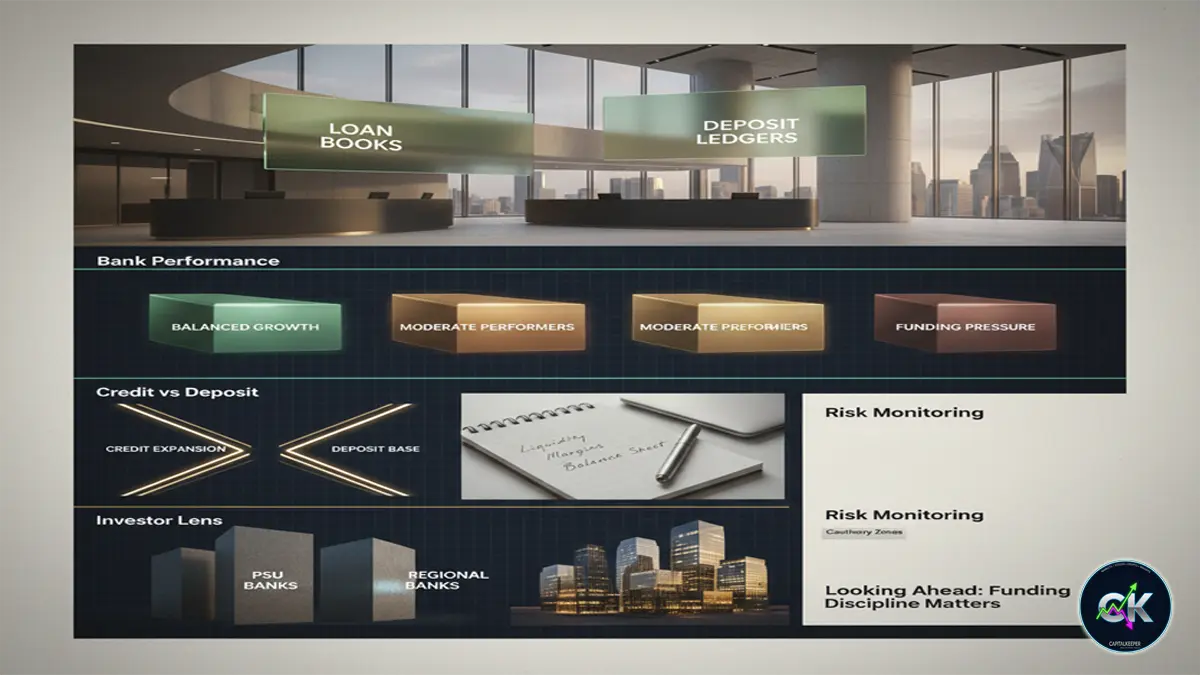
Credit–Deposit Growth Heatmap Q3 FY26: What Indian Banks Reveal About Liquidity, Growth & Risk
Updated: 15 Decmber 2025
Category: Pre Market | Market Analysis
By CapitalKeeper Research Desk
Analyze Q3 FY26 credit and deposit growth trends across Indian banks. Discover which PSU, private, and regional banks show balanced growth, funding stress, and long-term investment potential.
🏦 Credit–Deposit Growth Heatmap Q3 FY26: What Bank Balance Sheets Are Quietly Telling Investors
As the Indian banking sector moves deeper into FY26, headline numbers like index performance and quarterly profits often steal the spotlight. Yet beneath these surface metrics lies a quieter, more telling indicator of banking health — credit and deposit growth dynamics.
Q3 FY26 has offered a revealing snapshot of how different banks are navigating the evolving liquidity environment, customer behavior, and competitive pressures. Some banks are expanding loan books aggressively, others are struggling to mobilize deposits, while a few have achieved a rare balance between growth and funding stability.
This Credit–Deposit Growth Heatmap is not just a data table — it is a lens into future margins, risk profiles, and earnings sustainability.
Why Credit–Deposit Growth Matters More Than Ever
In a stable interest rate environment, banks thrive when credit growth and deposit growth move in sync. When loans grow faster than deposits, funding costs rise, reliance on wholesale borrowing increases, and margins can compress. On the other hand, sluggish credit growth despite strong deposits may signal underutilized balance sheets or weak demand.
In FY26, this balance has become especially critical due to:
- Tight systemic liquidity at times
- Increased competition for retail deposits
- Higher sensitivity of depositors to interest rates
- Growing regulatory scrutiny on asset–liability mismatches
Against this backdrop, Q3 FY26 numbers reveal clear divergence in strategies and execution quality across banks.
PSU Banks: Stability with Selective Stress Points
Union Bank of India: Credit Expansion Without Deposit Support
Union Bank reported credit growth of 7.1% and deposit growth of just 3.4%, placing it in the weaker zone for deposit mobilization.
This widening gap raises a few important questions:
- Is loan growth being supported through higher-cost bulk deposits or market borrowings?
- Can margins sustain if deposit traction remains weak?
- Will credit growth moderate in coming quarters to restore balance?
From an investor perspective, Union Bank’s data suggests monitoring rather than immediate concern, but funding pressure could limit upside unless deposit growth improves meaningfully.
Punjab National Bank (PNB): Gradual Normalization
PNB delivered credit growth of 11.0% and deposit growth of 8.5%, reflecting a more balanced PSU performance.
This suggests:
- Controlled expansion of the loan book
- Improved deposit franchise compared to earlier years
- A focus on steady retail and MSME lending
PNB’s numbers do not signal aggressive growth, but they indicate structural stabilization, which long-term investors often prefer in large PSU banks.
Bank of India & Indian Bank: Predictable and Consistent
Both banks fall squarely in the moderate zone:
- Bank of India: Credit 13.6%, Deposits 11.6%
- Indian Bank: Credit 14.5%, Deposits 12.5%
This alignment indicates:
- Healthy demand for loans
- Adequate deposit mobilization to fund growth
- Limited near-term margin stress
For conservative investors, such banks offer lower volatility and steady compounding potential, even if they lack the excitement of high-growth names.
Smaller & Regional Banks: The Real Story of Outperformance
CSB Bank: Retail-Focused Momentum
CSB Bank stands out sharply with credit growth of 29% and deposit growth of 21%, both firmly in the strong zone.
This performance reflects:
- Aggressive retail and gold loan expansion
- Strong traction in CASA and term deposits
- Improved customer acquisition and branch productivity
However, high growth always carries execution risk. Sustaining asset quality while growing at this pace will be the key variable investors should track going forward.
Karur Vysya Bank: The Gold Standard of Balance
With credit growth of 17.2% and deposit growth of 15.6%, Karur Vysya Bank emerges as one of the best-balanced performers in the heatmap.
What makes this notable:
- Growth is strong, but not reckless
- Deposit growth almost mirrors credit expansion
- Indicates disciplined underwriting and funding strategy
For investors, this combination often precedes stable ROA expansion and predictable earnings, making it a quiet compounder candidate.
Tamilnad Mercantile Bank: Conservative Strength
Tamilnad Mercantile Bank posted credit growth of 16.3% and deposit growth of 12.5%, reflecting steady expansion anchored in its strong regional franchise.
Key positives:
- Loyal depositor base
- Strong SME and retail lending mix
- Lower dependency on wholesale funding
This profile suits investors looking for capital protection with moderate growth rather than aggressive expansion.
South Indian Bank: Signs of Turnaround
South Indian Bank recorded credit growth of 11.3% and deposit growth of 12.2%, indicating a rare instance where deposits are growing faster than credit.
This suggests:
- Improving depositor confidence
- Conservative loan growth as the bank strengthens its base
- Potential for higher credit growth later without funding stress
Such patterns often appear in early stages of a balance sheet turnaround, making this bank worth watching rather than chasing.
PSU vs Private: Structural Differences Are Clear
The heatmap highlights a consistent theme:
- PSU banks show moderate, controlled growth with occasional deposit stress
- Private and regional banks demonstrate sharper execution, faster growth, and better deposit traction
This divergence reflects:
- Faster decision-making in private banks
- Stronger customer engagement at regional banks
- PSU banks still balancing legacy systems with modernization
For investors, this reinforces the importance of bank selection rather than sector-wide bets.
Funding Pressure: The Silent Risk Indicator
Banks where credit growth significantly exceeds deposit growth deserve special attention. While loan expansion boosts interest income in the short term, persistent funding gaps can:
- Increase cost of funds
- Compress net interest margins
- Introduce refinancing risks
In Q3 FY26, Union Bank and UCO Bank fall into this watchlist category. This does not imply immediate trouble, but it suggests less room for aggressive valuation re-rating unless deposit momentum improves.
Investor Takeaways: Reading Between the Lines
From an investor’s lens, this heatmap offers three powerful signals:
- Balanced growth matters more than high growth
Banks like Karur Vysya and Indian Bank may outperform over time despite lower headline excitement. - Retail and RAM-focused lenders are winning
CSB Bank, Tamilnad Mercantile, and regional banks benefit from sticky deposits and granular lending. - Funding discipline will define FY26 winners
In a competitive deposit environment, banks with strong franchises will protect margins better.
The Road Ahead: What to Watch in Q4 and Beyond
As FY26 progresses, investors should track:
- Deposit growth acceleration or slowdown
- Changes in CASA ratios
- Loan mix shifts toward retail vs corporate
- Management commentary on funding costs
The banks that maintain credit momentum without sacrificing deposit quality are likely to emerge as long-term outperformers.
Final Thought
The Q3 FY26 Credit–Deposit Growth Heatmap tells a nuanced story. It shows that India’s banking sector is healthy, but not uniform. Growth is selective, discipline is being tested, and execution quality is increasingly visible through simple metrics.
For investors willing to look beyond quarterly profits, credit–deposit alignment may be one of the most underappreciated signals of sustainable banking performance in the current cycle.
📌 For daily trade setups, technical learning, and smart investing tips, stay tuned to CapitalKeeper.in
📌 For more real-time updates, trade setups, and investment insights — follow us on [Telegram] and [WhatsApp Channel] subscribe to our newsletter!

Subscribe Now , Join Telegram the Crypto Capital Club, Get Free Crypto Updates
📌 Disclaimer
The content provided on CapitalKeeper.in is for informational and educational purposes only and does not constitute investment, trading, or financial advice. While we strive to present accurate and up-to-date market data and analysis, we make no warranties or representations regarding the completeness, reliability, or accuracy of the information.
Stock market investments are subject to market risks, and readers/investors are advised to conduct their own due diligence or consult a SEBI-registered financial advisor before making any investment decisions. CapitalKeeper and its authors are not liable for any loss or damage, direct or indirect, arising from the use of this information.
All views and opinions expressed are personal and do not reflect the official policy or position of any agency or organization. Past performance is not indicative of future results.By using this website, you agree to the terms of this disclaimer.
Ranjit Sahoo
Founder & Chief Editor – CapitalKeeper.in
Ranjit Sahoo is the visionary behind CapitalKeeper.in, a leading platform for real-time market insights, technical analysis, and investment strategies. With a strong focus on Nifty, Bank Nifty, sector trends, and commodities, she delivers in-depth research that helps traders and investors make informed decisions.
Passionate about financial literacy, Ranjit blends technical precision with market storytelling, ensuring even complex concepts are accessible to readers of all levels. Her work covers pre-market analysis, intraday strategies, thematic investing, and long-term portfolio trends.
When he’s not decoding charts, Ranjit enjoys exploring coastal getaways and keeping an eye on emerging business themes.
📌 Follow Ranjit on:
LinkedIn | Twitter/X | Instagram | ✉️ contact@capitalkeeper.in











Leave a Reply