
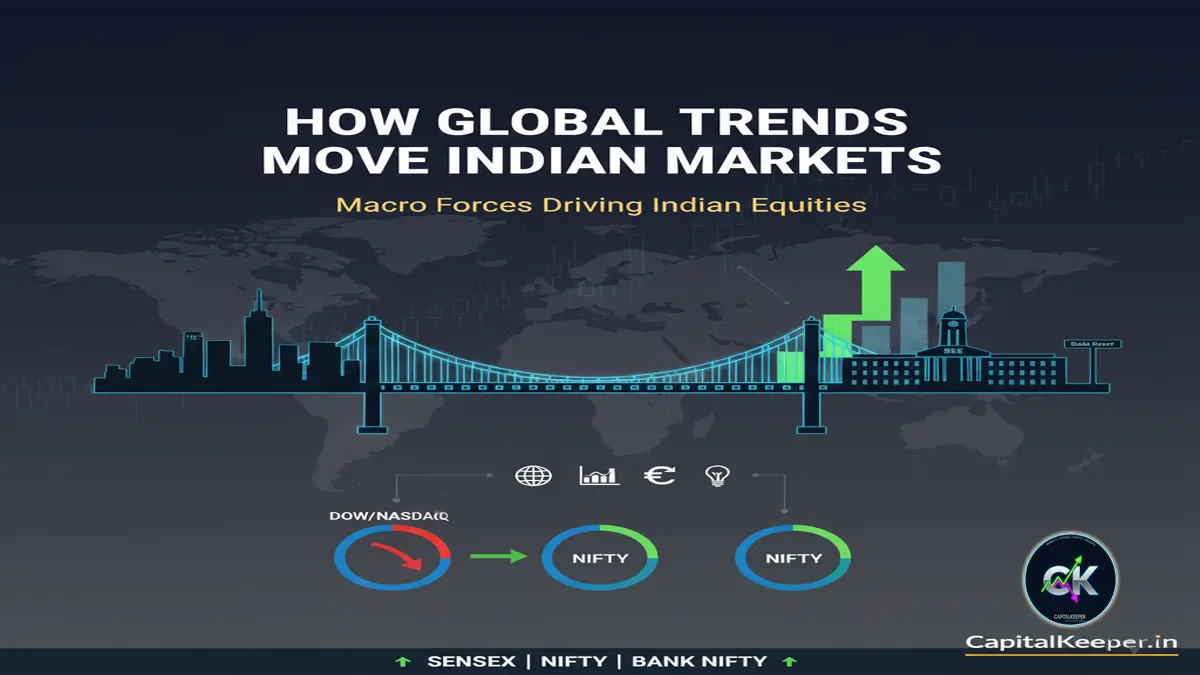
How Global Market Trends Impact Indian Equities — A Complete Investor Guide
Updated: 24 November 2025
Category: Beginner’s Guide | Market Analysis
By CapitalKeeper Research Desk
Introduction
Indian equities are often celebrated for strong domestic consumption, demographics, and structural reforms. Yet, the reality modern investors must accept is this—
The Indian stock market does not move in isolation.
Whether it’s a sudden fall in Nasdaq, a spike in US bond yields, Middle East geopolitical tension, or China’s manufacturing slowdown—global developments ripple into Dalal Street within minutes.
For traders, understanding this interconnectedness can prevent premature entries, panic exits, and emotional decision-making. For long-term investors, it provides a framework to ride cycles and allocate sectors based on global macro direction.
This article breaks down how global markets influence Indian equities, and how traders can validate global signals using RSI, MACD, and Volume before acting.
✅ Why Global Trends Shape Indian Markets
India is the world’s fastest-growing large economy, but it remains deeply linked through:
- Foreign Institutional Investment (FII) flows
- Global trade and currency movements
- Commodity pricing—especially crude
- Technology, banking, and energy exposure
- Geopolitical risk premiums
- Derivatives and ETF participation in emerging markets
So when macro sentiment shifts globally, Indian markets react—not necessarily because fundamentals changed, but because capital repositioned.
✅ Key Global Indicators That Affect Indian Equities
| Global Factor | How It Impacts India | Market Impact |
|---|---|---|
| Dow Jones, S&P 500, Nasdaq | Sentiment, tech sector cues | Positive/Negative opening |
| US Bond Yields (10Y) | Cost of capital, FII flows | Higher yields → market weakness |
| Dollar Index (DXY) | Rupee valuation | Strong DXY → FII outflows |
| Crude Oil Prices | Inflation, fiscal deficit | Rising crude → pressure on equities |
| China PMI/slowdown | Global demand | Mixed—benefits Indian exporters |
| MSCI EM Flows | Weightage change | Higher inclusion → inflows |
| Fed Policy | Liquidity cycle | Rate hikes bearish for emerging markets |
Investors who monitor these factors anticipate market reactions—not chase them.
✅ How US Markets Influence Indian Equities
The US remains the world’s financial anchor.
- Nasdaq dictates momentum in Nifty IT
- S&P 500 influences global allocation to India
- Fed commentary hits Indian currency & debt markets first
When US indices break key technical levels with strong volume, Nifty often mirrors sentiment the next day—especially during pre-market SGX/Nifty derivatives trade.
Technical Lens:
- If Nasdaq shows MACD bullish crossover + rising volume, Indian IT stocks usually attempt short-term rallies.
- RSI moving above 55–60 indicates supportive momentum for Indian tech-heavy portfolios.
✅ US Dollar Index (DXY) & Rupee — The Most Underrated Metric
A rising DXY strengthens the dollar, making emerging market assets riskier for FIIs.
- Strong DXY → Rupee weakens → FII outflows
- Weak DXY → Rupee strengthens → Indian equities benefit
Trading Interpretation:
If Nifty is near resistance but DXY is surging, expect selling pressure.
Use indicators:
- RSI dropping below 50
- Declining volume on up-days
- MACD flattening
All signal weakening breakout potential.
✅ Impact of Crude Oil on Indian Stock Market
India imports ~85% of its crude requirements.
- Rising crude → inflation, higher CAD, lower margins
- Falling crude → reduced fiscal burden, stronger earnings
Sectors most affected:
- Aviation, paint, chemical, logistics — bearish if crude surges
- Oil marketing companies — bullish if crude cools
For positional trades:
- Look for RSI climbing above 60 on OMC stocks when Brent falls
- MACD crossover + rising volume confirms sustainable trend
✅ China’s Economic Performance & Indian Equities
China’s slowdown has two outcomes:
✅ Global funds diversify into India → inflows
✅ Commodity prices drop → benefit metals, auto & manufacturing
But Chinese stimulus—especially infrastructure—can lift metal prices globally, affecting Indian producers differently.
So for metal stocks:
- Watch for Volume spike on breakout
- RSI between 55–70
- MACD crossing above zero line
✅ FIIs — The Most Immediate Transmission Channel
Global risk sentiment determines inflows vs. outflows.
- Risk-on → FIIs buy India → Nifty rallies
- Risk-off → FIIs sell → domestic institutions defend support
Tracking FII data is as important as tracking price action.
A bullish FII trend + rising OI & volume = strong breakout probability.
✅ How India VIX Responds to Global Volatility
If VIX rises due to global uncertainty, expect temporary correction or sideways consolidation.
High VIX + low volume = weak conviction rally
Falling VIX + rising volume = breakout readiness
During global event weeks (Fed, ECB, jobs data), avoid sizing up trades.
✅ Case Study — Global Impact Playbook
Imagine this scenario:
- Dow Jones falls 1.8% overnight
- US 10-year bond yield jumps above 4.7%
- DXY crosses 107
- Brent crude rises to $92
- FIIs sell ₹1,500 crore in cash market
Next morning:
- Nifty may open gap-down
- Banking & IT weaken first
- PSU & high-beta stocks fall sharply
Now include technical confirmation:
- Nifty RSI drops from 58 → 47
- MACD turns negative
- Volume increases on red candles
This confirms global sentiment is translating into domestic price action—not random volatility.
✅ How Traders Should Use RSI, MACD & Volume with Global Cues
RSI
- RSI above 60 + supportive global cues → high-probability continuation
- RSI below 45 after negative global triggers → deeper correction risk
MACD
- MACD crossover confirms whether global move has momentum or is noise
- MACD above zero line is strong for trend-following trades
Volume
- Indian markets reacting to global signals on high volume = conviction
- Weak volume = temporary knee-jerk reaction
✅ Do Global Trends Always Control Indian Equities?
Not always.
India outperforms when:
- Corporate earnings beat expectations
- Domestic SIP flows rise
- Government policies support capex
- Global institutions increase EM weightage
India underperforms when:
- FIIs exit aggressively
- Inflation fears return
- Global liquidity dries up
The balance between domestic and global drivers remains dynamic.
✅ Table: Sector Sensitivity to Global Trends
| Sector | Highly Sensitive To |
|---|---|
| IT | Nasdaq, US GDP |
| Banks | Bond yields, currency |
| Metals | China, global demand |
| Oil & Gas | Crude prices |
| Pharma | US FDA, global health trends |
| Auto | Commodity prices |
| FMCG | Inflation & currency |
✅ Internal Links for CapitalKeeper.in
- How to Identify True Breakout Stocks
- Sector Rotation Strategy for Swing Traders
- Top Intraday Trading Rules Every Trader Must Follow
✅ FAQs
1. Do Indian markets always follow US markets?
Not always—but sentiment & opening direction are heavily influenced.
2. Why does crude oil matter to Indian stocks?
India is a major oil importer—higher prices increase inflation & deficit.
3. Which indicator best validates global market impact?
Volume + MACD trend change confirms actual market participation.
4. Can RSI predict global-driven corrections?
Yes—RSI falling below 50 after global weakness signals trend reversal.
5. Are long-term investors affected by global volatility?
Short-term volatility yes—long-term allocation remains fundamentals-driven.
✅ Final Thoughts
Global markets act as the wind Indian equities are the sails. Neither operates without the other. Successful traders and investors do not react emotionally they observe global cues, validate with technical indicators, and align positions accordingly.
When price action, volume, RSI, MACD, and global sentiment agree that’s when high-probability opportunities emerge.
📌 For daily trade setups, technical learning, and smart investing tips, stay tuned to CapitalKeeper.in
📌 For more real-time updates, trade setups, and investment insights — follow us on [Telegram] and [WhatsApp Channel] subscribe to our newsletter!

Subscribe Now , Join Telegram the Crypto Capital Club, Get Free Crypto Updates
📌 Disclaimer
The content provided on CapitalKeeper.in is for informational and educational purposes only and does not constitute investment, trading, or financial advice. While we strive to present accurate and up-to-date market data and analysis, we make no warranties or representations regarding the completeness, reliability, or accuracy of the information.
Stock market investments are subject to market risks, and readers/investors are advised to conduct their own due diligence or consult a SEBI-registered financial advisor before making any investment decisions. CapitalKeeper and its authors are not liable for any loss or damage, direct or indirect, arising from the use of this information.
All views and opinions expressed are personal and do not reflect the official policy or position of any agency or organization. Past performance is not indicative of future results.By using this website, you agree to the terms of this disclaimer.
Ranjit Sahoo
Founder & Chief Editor – CapitalKeeper.in
Ranjit Sahoo is the visionary behind CapitalKeeper.in, a leading platform for real-time market insights, technical analysis, and investment strategies. With a strong focus on Nifty, Bank Nifty, sector trends, and commodities, she delivers in-depth research that helps traders and investors make informed decisions.
Passionate about financial literacy, Ranjit blends technical precision with market storytelling, ensuring even complex concepts are accessible to readers of all levels. Her work covers pre-market analysis, intraday strategies, thematic investing, and long-term portfolio trends.
When he’s not decoding charts, Ranjit enjoys exploring coastal getaways and keeping an eye on emerging business themes.
📌 Follow Ranjit on:
LinkedIn | Twitter/X | Instagram | ✉️ contact@capitalkeeper.in










Leave a Reply