

How Investors Can Navigate 2025 with Confidence: Volatility, Macro Risk & Asset Allocation Shifts
By CapitalKeeper | Beginner’s Guide | Indian Equities | Market Moves That Matter
Explore how global volatility, inflation cycles, monetary policy divergence, and geopolitical tensions are reshaping investment behaviour in 2025. Understand why fixed-income and Indian bond markets may play a bigger role in asset allocation this year.
Introduction
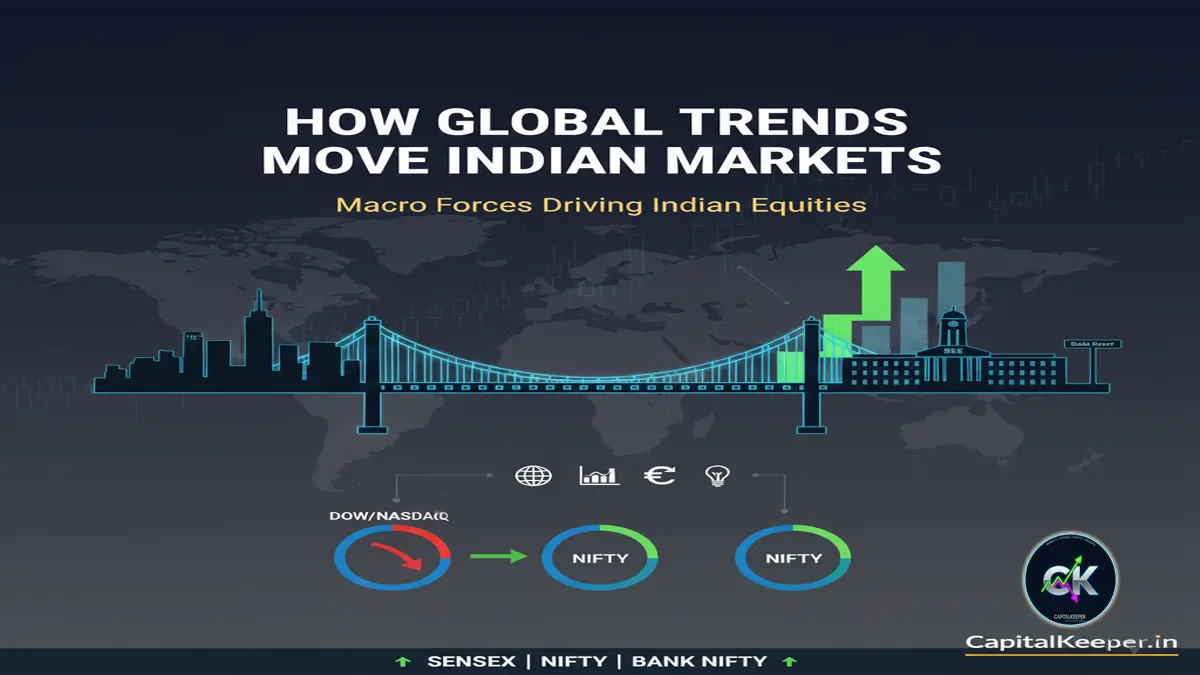
The global financial landscape heading into 2025 is unlike any other period in recent memory. Investors are dealing with inflation that refuses to sit still, monetary policies moving in different directions across economies, volatile commodity markets, and geopolitical tensions that create sudden market shocks. These factors are shaping a new era of portfolio strategy—one where asset allocation is no longer static.
For years, the conversation was dominated by equities, especially with the liquidity-driven rallies of the early 2020s. But now, the winds have shifted. Debt markets are again entering the spotlight as investors seek stability amid uncertainty.
This is not a temporary adjustment. It’s a structural shift.
In this blog, let’s break down the global macro forces driving volatility and why 2025 could be the year investors start giving more weight to fixed-income and Indian debt markets.
Macro Forces Driving Volatility in 2025
1. Divergent Monetary Policy
For the first time in decades, central banks are not moving in a unified direction.
- The US Federal Reserve is still signalling caution, balancing between rate cuts and concerns about inflation re-acceleration.
- The European Central Bank is more aggressive with its easing cycle due to slow growth.
- Asian central banks, including India’s RBI, remain focused on price stability before easing monetary conditions.
This imbalance creates ripple effects:
- Currency volatility increases.
- Global bond yields move unpredictably.
- Capital flows become choppy.
- Risk premiums widen during uncertainty.
This means investors cannot place blind bets on high-growth equities without accounting for policy-induced price swings.
2. Inflation Is Cooling, But Not in a Straight Line
Global inflation is easing, but unevenly. Components like energy, food, and supply-chain-dependent goods continue to surprise markets.
Factors disturbing inflation stability:
- Ongoing supply chain fragmentation
- Weather-related disruptions in agriculture
- Commodity hoarding by certain regions
- Energy market uncertainty (especially oil and gas)
This inconsistent inflation path forces investors to hedge both upside and downside shocks—making traditional 60:40 portfolios less reliable.
3. Commodities Back in Focus
Commodity markets in 2025 are deeply influenced by:
- Middle East tensions
- Russia–Ukraine spillovers
- Global shipping disruptions
- Renewable energy transition
- Strategic oil reserve decisions
Crude oil, gold, industrial metals, and agricultural commodities are all seeing structural volatility.
For investors, commodities are no longer a passive hedge—they’re becoming a strategic part of portfolio construction.
4. Geopolitics as a Financial Risk Factor
Geopolitical instability is now a primary market driver, not a secondary one.
Key hotspots shaping 2025 markets:
- Middle East conflicts
- China–Taiwan tensions
- Russia–Ukraine extensions
- Global trade realignment
- Regionalisation replacing globalisation
These disruptions influence:
- Foreign institutional flows
- Currency valuations
- Import costs
- Supply chain reliability
Volatility is the new normal—and investors must build portfolios that can survive shocks, not just ride rallies.
Asset Allocation Shifts in 2025: The New Playbook
Equity exuberance is softening
Equities are still attractive, especially in India, where domestic liquidity continues to support the market. But globally, cracks are visible:
- Earnings downgrades are becoming common
- Valuations remain stretched
- Institutional portfolios are rotating into defensives
Investors are no longer willing to pay high multiples for uncertain earnings growth.
Debt Markets Are Back in the Limelight
One of the biggest trends this year is the renewed preference for fixed-income assets.
Why?
- Yield Stability
With interest rates near their peak, high-grade bonds offer attractive yields without equity-level risk. - Lower Volatility
Debt markets act as a buffer against macro shocks. - Carry Trade Opportunities
India remains one of the highest-yielding stable markets globally. - Global Bond Index Inclusion
India’s sovereign bonds entering major global indices could bring $20–25 billion of inflows over the next 1–2 years. - Corporate Bond Market Maturity
Investors now have access to diversified corporate debt instruments with better credit transparency.
This shift is not cyclical—it’s structural.
Why Indian Fixed-Income Markets Matter More in 2025
India’s fixed-income ecosystem is becoming more relevant than ever for global and domestic investors.
1. Attractive Real Yields
India continues to offer one of the highest real interest rates among major emerging economies.
2. Rising Foreign Participation
Index inclusion is expected to:
- Lower India’s cost of borrowing
- Increase liquidity
- Enhance price discovery
- Bring sovereign bonds into global spotlight
3. Corporate Bond Growth
Corporate debt issuances are rising in sectors like:
- Banking & NBFC
- Renewable energy
- Infrastructure
- Telecom
- Manufacturing
Improved ratings frameworks and default recognition systems have made corporate bonds safer.
4. Stability During Volatility
While equities face mood swings from FIIs and global cues, debt markets provide predictable cash flows and defensive returns.
5. Retail Participation Is Expanding
Thanks to platforms and awareness:
- G-Sec Direct
- RBI Retail Direct
- Bond ETFs
- Target Maturity Funds
Retail investors now have access to what once only institutions enjoyed.
How Should Investors Think About Asset Allocation in 2025?
2025 demands a mindset shift:
1. Balance Growth & Stability
A blend of equities and fixed-income is essential to withstand macro shocks.
Suggested balanced allocation approach:
- 40–55% equities (India-focused, quality names)
- 30–40% fixed-income (sovereign, TMFs, corporate)
- 5–10% commodities (gold, silver)
- 5–10% global diversification
2. Prioritise Quality
Stick to:
- High-quality balance sheets
- Strong cash flows
- Low leverage
- Companies with pricing power
3. Incorporate Bond ETFs & Target Maturity Funds
These offer:
- Tax efficiency
- Low risk
- Predictable yield
- Easy liquidity
4. Keep Currency & Global Risks in Mind
Global volatility can hit export-oriented sectors faster. India-facing themes should hold priority.
5. Keep Dry Powder
A cash allocation of 5–10% allows investors to buy dips during periodic corrections.
Conclusion
2025 is shaping up to be a year defined by macro uncertainty—but also by opportunity. While volatility may unsettle markets, it rewards investors who stay disciplined, diversified, and strategically positioned.
Indian debt markets are emerging as a central pillar in asset allocation due to attractive yields, rising global interest, and structural reforms. Combined with quality equities and hedges like gold, investors can build portfolios that stay resilient regardless of global shocks.
Preparing for uncertainty is no longer optional—it’s essential. And this year, smart asset allocation is the difference between surviving and thriving.
📌 For daily trade setups, technical learning, and smart investing tips, stay tuned to CapitalKeeper.in
📌 For more real-time updates, trade setups, and investment insights — follow us on [Telegram] and [WhatsApp Channel] subscribe to our newsletter!

Subscribe Now , Join Telegram the Crypto Capital Club, Get Free Crypto Updates
📌 Disclaimer
The content provided on CapitalKeeper.in is for informational and educational purposes only and does not constitute investment, trading, or financial advice. While we strive to present accurate and up-to-date market data and analysis, we make no warranties or representations regarding the completeness, reliability, or accuracy of the information.
Stock market investments are subject to market risks, and readers/investors are advised to conduct their own due diligence or consult a SEBI-registered financial advisor before making any investment decisions. CapitalKeeper and its authors are not liable for any loss or damage, direct or indirect, arising from the use of this information.
All views and opinions expressed are personal and do not reflect the official policy or position of any agency or organization. Past performance is not indicative of future results.By using this website, you agree to the terms of this disclaimer.
Ranjit Sahoo
Founder & Chief Editor – CapitalKeeper.in
Ranjit Sahoo is the visionary behind CapitalKeeper.in, a leading platform for real-time market insights, technical analysis, and investment strategies. With a strong focus on Nifty, Bank Nifty, sector trends, and commodities, she delivers in-depth research that helps traders and investors make informed decisions.
Passionate about financial literacy, Ranjit blends technical precision with market storytelling, ensuring even complex concepts are accessible to readers of all levels. Her work covers pre-market analysis, intraday strategies, thematic investing, and long-term portfolio trends.
When he’s not decoding charts, Ranjit enjoys exploring coastal getaways and keeping an eye on emerging business themes.
📌 Follow Ranjit on:
LinkedIn | Twitter/X | Instagram | ✉️ contact@capitalkeeper.in










Leave a Reply