
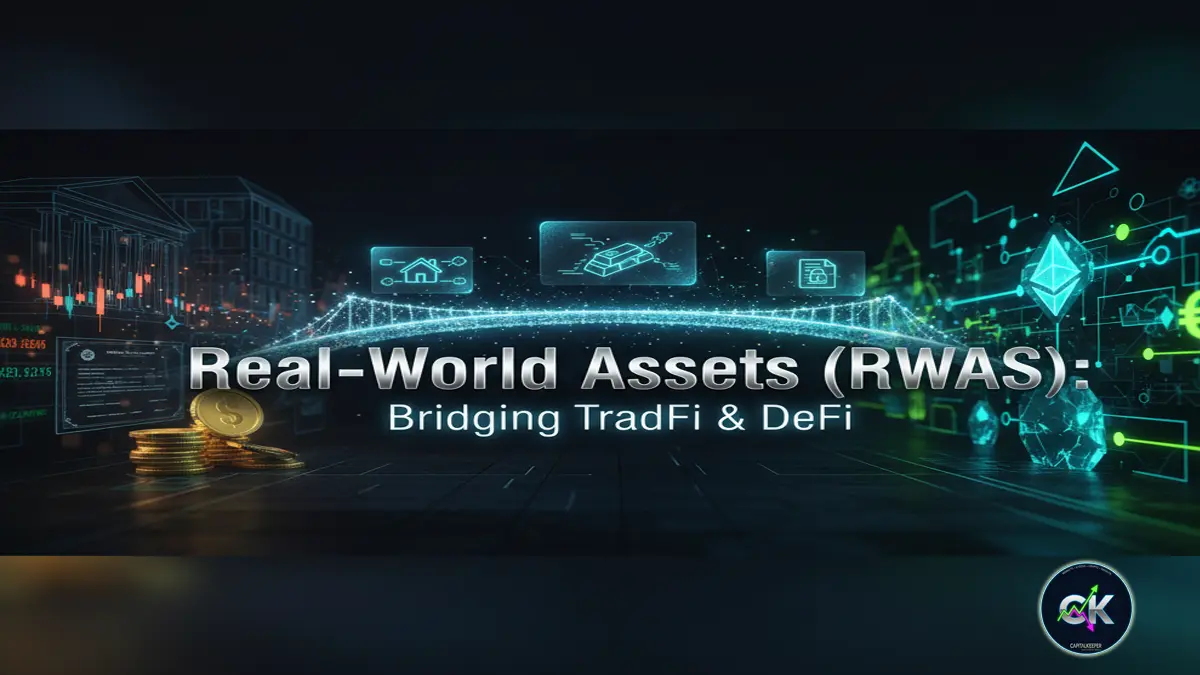
RWA Tokenization: How Real-World Assets on Blockchain Are Transforming Global Finance in 2025
By CapitalKeeper | Beginner’s Guide | Crypto Capital | Market Moves That Matter
RWA tokenization is bridging TradFi and DeFi by putting real estate, bonds, and commodities on blockchain. Explore how this trend is unlocking liquidity and reshaping finance in 2025.
Real-World Asset (RWA) Tokenization: The Bridge Between TradFi, DeFi & Global Capital in 2025
The financial world is witnessing a structural transformation that could rival the impact of the internet or mobile revolution: the tokenization of real-world assets (RWA). A decade ago, crypto was synonymous with speculative tokens and volatile trading. Today, the narrative has shifted. The most powerful trend across global financial markets is the digitization of real estate, government bonds, corporate debt, commodities, treasury products, invoices, and even luxury assets all on blockchain rails.
This shift is not hype. It is a deep, systemic evolution driven by institutional demand, regulatory clarity, technological maturity, and the push for more liquid and accessible markets. In 2025, RWA tokenization stands at the intersection of traditional finance (TradFi) and decentralized finance (DeFi) connecting two worlds that once seemed incompatible.
This blog explores the rise of RWAs, why institutions are paying attention, and how this revolution could unlock a multi-trillion-dollar opportunity in the coming decade.
1. The Rise of RWA Tokenization: Why This Narrative Matters Now
The concept is simple yet transformative:
Take a real asset → Digitize it → Represent it as tokens on blockchain → Enable fractional ownership, instant settlement, global liquidity, and 24/7 accessibility.
RWA tokenization isn’t just a crypto trend. It is a macro-financial evolution driven by:
- High interest rates and the demand for yield
- Growing institutional comfort with blockchain rails
- Regulatory frameworks emerging in the U.S., EU, Singapore, and UAE
- Technological breakthroughs in scaling, compliance, and custody
In 2025, global banks, asset managers, sovereign institutions, and fintech lenders are actively exploring how tokenization can simplify operations, reduce costs, and expand investor participation.
This narrative matters because RWAs represent 95%+ of the world’s financial assets, and tokenizing even a fraction can reshape how capital flows across borders and markets.
2. What Exactly Are Real-World Assets (RWAs)?
RWAs refer to physical or financial assets outside the crypto world that are digitized via blockchain tokens. These tokens represent:
- Ownership
- Economic rights
- Income flows
- Collateral rights
- Settlement claims
Examples include:
🟢 Real Estate
Commercial buildings, residential property, rental income rights
→ Tokenized REITs or fractional ownership tokens
🟢 Bonds & Treasury Products
T-bills, government securities, corporate bonds
→ One of the fastest-growing segments
→ Used for on-chain savings, staking, and lending
🟢 Commodities
Gold, silver, oil, carbon credits
→ Tradeable as digital tokens representing real inventory
🟢 Private Credit & Invoices
Supplier invoices, SME loans, fintech credit
→ Major opportunity for yield-seeking investors
🟢 Luxury & Alternative Assets
Art, automobiles, music royalties
→ Democratizing access to previously exclusive markets
Together, these categories cover trillions in global value and tokenization is opening them to new forms of liquidity.
3. How RWA Tokenization Bridges TradFi & DeFi
At the heart of the trend is interoperability the merging of traditional financial frameworks with crypto infrastructure.
💠 From TradFi to DeFi
Banks, asset managers, and institutions use blockchain for:
- Faster settlements
- Lower operational costs
- Automated interest payments
- Transparent audits
- Tokenized collateral
- 24/7 global access to liquidity
💠 From DeFi to TradFi
Crypto protocols gain:
- Access to real-world yield
- High-quality collateral
- More stability vs volatile crypto assets
- Institutional-grade credibility
This synergy is why RWAs are becoming a central theme in global finance.
4. Why Institutions Are Embracing Tokenized RWAs
In 2025, the conversation has shifted from “Should we explore blockchain?” to
“How fast can we tokenize our assets?”
Here’s why institutional interest is booming:
⭐ 1. Yield Advantage
Tokenized bonds or T-bills on-chain offer higher real returns and automatic settlement.
⭐ 2. Operational Efficiency
Tokenization removes the need for intermediaries like custodians, transfer agents, and clearinghouses.
⭐ 3. Fractional Ownership & Liquidity
Real estate or bonds can be divided into thousands of micro-tokens—unlocking liquidity in markets traditionally considered illiquid.
⭐ 4. Global Investor Access
A tokenized asset can be legally accessed by investors across regions (depending on regulatory frameworks).
⭐ 5. Transparency & Compliance
Blockchain ensures end-to-end visibility of transactions, ownership, and settlement.
⭐ 6. Real-Time Settlements
Traditional systems take 1–3 days. Tokenized systems settle in seconds, reducing counterparty risk.
Institutions are recognizing that tokenization isn’t a crypto experiment it’s a modern infrastructure upgrade.
5. Real-World Use Cases Already Scaling in 2025
Tokenization is no longer theoretical. Major examples include:
🏦 1. U.S. Treasury Tokenization
Multiple asset managers now issue tokenized treasury funds, allowing global investors to earn regulated yield on-chain.
💼 2. Real Estate Fractionalization
Developers are selling fractional ownership of commercial buildings via blockchain tokens, democratizing access to lucrative real estate assets.
⚡ 3. Commodity Tokenization
Gold-backed tokens and carbon-credit tokens are becoming mainstream stores of value.
📄 4. Invoice & SME Lending
Fintech platforms tokenize invoices and business loans providing businesses with instant liquidity and investors with attractive yields.
🌱 5. Renewable Energy Credits (RECs)
RECs are being tokenized for transparent tracking, trading, and compliance.
The ecosystem is expanding rapidly, and billions of dollars are already flowing through tokenized products.
6. India’s Position in the RWA Tokenization Race
As one of the world’s fastest-growing digital economies, India plays a unique role:
🟠 1. Digital Infrastructure Strength
With UPI, ONDC, DigiLocker, and Account Aggregator, India has the digital backbone to support seamless tokenization.
🟠 2. Growing Fintech & Startup Ecosystem
Indian fintechs are exploring tokenized lending, asset-backed credit, and blockchain-driven compliance.
🟠 3. Real-Estate Tokenization Potential
India’s real estate market one of the largest globally is set for a major liquidity unlock through fractional ownership.
🟠 4. Commodity Tokenization
Gold, agriculture produce, and carbon markets offer natural tokenization opportunities.
🟠 5. Regulatory Monitoring
While India has not released a formal tokenization framework, policy discussions are ongoing especially on security tokens and CBDC interaction.
India is positioned to benefit massively when regulatory clarity is established.
7. Risks & Challenges: What’s Holding Back Full Adoption?
Despite its promise, tokenization faces hurdles:
- Regulatory uncertainty in emerging markets
- Custody and security concerns
- Inter-jurisdictional compliance issues
- Institutional hesitation due to operational complexity
- Market education gaps
However, the momentum is undeniable and every year brings greater clarity and adoption.
8. The Future: A $10 Trillion Tokenized Economy?
Industry estimates suggest:
- $3–4 trillion in tokenized bonds and treasuries
- $1–2 trillion in tokenized real estate
- $1 trillion+ in tokenized private credit
- $500–700 billion in commodities and alternatives
By 2030, tokenization could be bigger than the entire crypto market today.
This isn’t a trend it’s a transition. The financial system of the future will be hybrid, digital-first, programmable, and global. RWAs will be its core building block.
Conclusion: Tokenization Is Reshaping Financial Markets
Real-World Asset (RWA) tokenization is not merely a technological upgrade it’s a redefinition of financial architecture. It merges:
- TradFi’s trust
- DeFi’s efficiency
- Blockchain’s transparency
In 2025 and beyond, RWAs will be the driving force behind institutional crypto adoption and global capital flows.
📌 For daily trade setups, technical learning, and smart investing tips, stay tuned to CapitalKeeper.in
📌 For more real-time updates, trade setups, and investment insights — follow us on [Telegram] and [WhatsApp Channel] subscribe to our newsletter!

Subscribe Now , Join Telegram the Crypto Capital Club, Get Free Crypto Updates
📌 Disclaimer
The content provided on CapitalKeeper.in is for informational and educational purposes only and does not constitute investment, trading, or financial advice. While we strive to present accurate and up-to-date market data and analysis, we make no warranties or representations regarding the completeness, reliability, or accuracy of the information.
Stock market investments are subject to market risks, and readers/investors are advised to conduct their own due diligence or consult a SEBI-registered financial advisor before making any investment decisions. CapitalKeeper and its authors are not liable for any loss or damage, direct or indirect, arising from the use of this information.
All views and opinions expressed are personal and do not reflect the official policy or position of any agency or organization. Past performance is not indicative of future results.By using this website, you agree to the terms of this disclaimer.
Ranjit Sahoo
Founder & Chief Editor – CapitalKeeper.in
Ranjit Sahoo is the visionary behind CapitalKeeper.in, a leading platform for real-time market insights, technical analysis, and investment strategies. With a strong focus on Nifty, Bank Nifty, sector trends, and commodities, she delivers in-depth research that helps traders and investors make informed decisions.
Passionate about financial literacy, Ranjit blends technical precision with market storytelling, ensuring even complex concepts are accessible to readers of all levels. Her work covers pre-market analysis, intraday strategies, thematic investing, and long-term portfolio trends.
When he’s not decoding charts, Ranjit enjoys exploring coastal getaways and keeping an eye on emerging business themes.
📌 Follow Ranjit on:
LinkedIn | Twitter/X | Instagram | ✉️ contact@capitalkeeper.in


Leave a Reply