
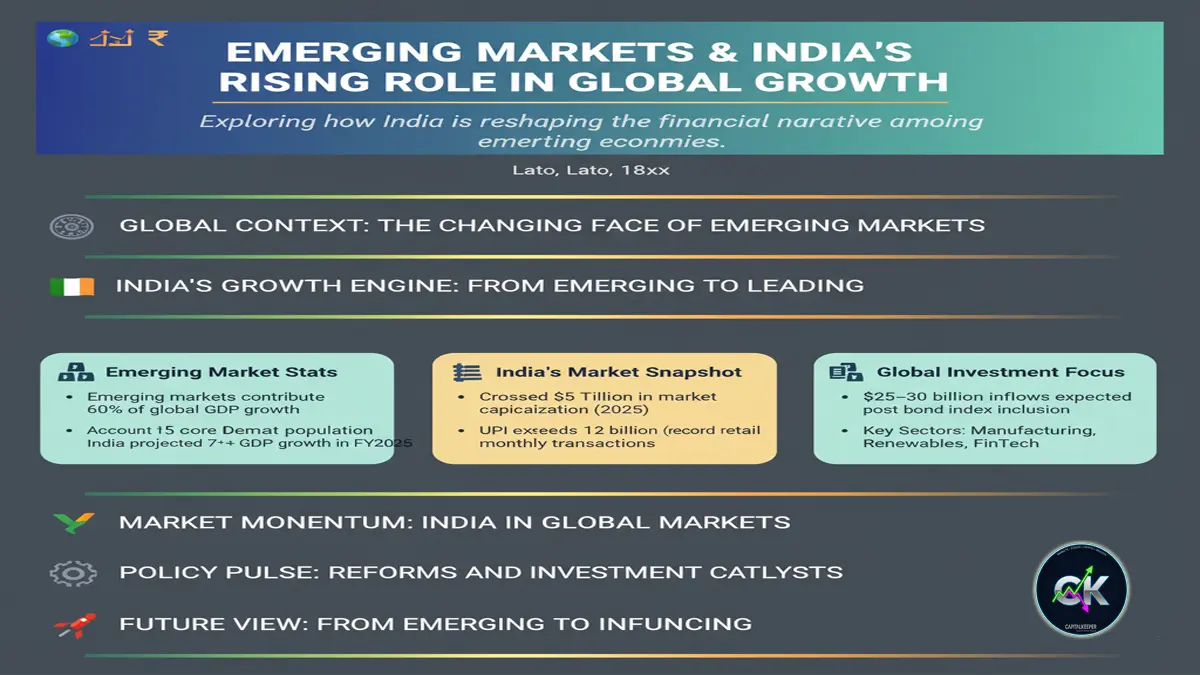
Emerging Markets & India’s Rising Role in Global Growth: The New Financial Powerhouse
By CapitalKeeper | Beginner’s Guide | Indian Equities | Market Moves That Matter
Explore how India is shaping the future of emerging markets through rapid digitalization, manufacturing reforms, and FDI inflows. A detailed financial analysis of India’s evolving global role.
Emerging Markets & India’s Rising Role in Global Growth
The global financial landscape is undergoing a powerful transformation. Emerging markets, once viewed as volatile or secondary players, are now driving much of the world’s growth momentum. Among them, India stands out as the fastest-growing large economy, blending demographic strength, policy reforms, and digital innovation to emerge as a global growth engine.
In this blog, we explore how India’s evolving role in the global economy is shaping investment trends, market behavior, and long-term capital flows and why global investors are betting big on the Indian story.
1. The Changing Face of Emerging Markets
Emerging markets (EMs) such as India, Indonesia, Brazil, Vietnam, and South Africa account for nearly 60% of global GDP growth and over 80% of the world’s population. The financial narrative has shifted from the developed West to the dynamic South and East.
Key Drivers of EM Growth
- Demographics: Young, aspirational populations drive consumption and entrepreneurship.
- Urbanization: Rapid city expansion leads to higher infrastructure and housing demand.
- Digital Transformation: Fintech and digital inclusion redefine access to capital and markets.
- Reform Momentum: Market liberalization, ease of business, and fiscal stability attract FDI.
While China’s economy matures, India emerges as the most promising successor to lead the EM bloc in the next decade.
2. India’s Economic Transformation: From Emerging to Leading
India’s GDP, now above $4 trillion in nominal terms, is projected to become the world’s third-largest economy by 2030, trailing only the U.S. and China.
Several pillars underpin India’s growing prominence:
a. Manufacturing & ‘Make in India’ Push
The government’s Make in India and PLI (Production-Linked Incentive) schemes have spurred domestic manufacturing in electronics, automobiles, and pharmaceuticals.
- Global majors like Apple, Foxconn, and Samsung have ramped up production in India.
- India aims to become a manufacturing alternative to China, especially in electronics and semiconductors.
b. Infrastructure Boom
Massive public investment in roads, ports, railways, and airports is transforming connectivity.
The National Infrastructure Pipeline (NIP) and Gati Shakti mission are expected to mobilize over ₹100 lakh crore in the coming decade.
c. Digital & Financial Inclusion
The India Stack comprising Aadhaar, UPI, and Jan Dhan has revolutionized digital payments and financial inclusion.
UPI transactions now exceed 12 billion monthly, making India the world leader in real-time digital payments.
d. Foreign Direct Investment (FDI)
India attracted over $70 billion FDI in FY2024, across technology, renewable energy, and manufacturing.
Global investors view India as a structural growth story, not a cyclical opportunity.
3. India in Global Markets: The Investment Magnet
Global investors are recalibrating portfolios to capture India’s growth potential. The country is now a core holding in most Emerging Market (EM) ETFs and sovereign wealth fund allocations.
a. Inclusion in Global Bond Indexes
India’s upcoming inclusion in the JP Morgan Global Bond Index (2025) is a historic milestone.
It could attract over $25–30 billion in foreign inflows into Indian government securities, boosting rupee liquidity and lowering borrowing costs.
b. Equity Market Depth & Retail Participation
The NSE and BSE have seen a surge in Demat accounts (over 15 crore), driven by young retail investors.
India’s market capitalization crossed $5 trillion in 2025, making it the world’s fourth-largest equity market after the U.S., China, and Japan.
c. Sectoral Magnetism
Key investment themes gaining global attention include:
- Green Energy & Renewables – Adani Green, Tata Power, and NTPC.
- Digital & AI Infrastructure – Infosys, TCS, HCL Tech, and new-age SaaS startups.
- Financial Services Expansion – HDFC Bank, Kotak Mahindra, and Bajaj Finance leading credit penetration.
4. Geopolitical Tailwinds: A World Turning Toward India
In a multipolar world, India’s strategic neutrality and stable democracy enhance its appeal.
- The China+1 strategy has pushed global manufacturers to diversify to India.
- India’s role in the Quad Alliance (U.S., Japan, Australia, India) boosts defense and tech collaborations.
- Rising trade with the Middle East and Europe via new corridors (IMEC) is reshaping global supply chains.
India’s foreign policy pragmatism, energy diplomacy, and tech-driven governance stand in contrast to several volatile EM peers.
5. Domestic Strength: Consumption & Capital Formation
India’s domestic story remains unmatched:
- Private Consumption: Contributes nearly 60% of GDP, powered by an expanding middle class.
- Investment Cycle Revival: Capex by both private and public sectors is accelerating.
- Credit Growth: Banking sector NPAs have dropped to multi-year lows, fueling lending confidence.
- Fiscal Stability: The fiscal deficit is under control near 5.1% of GDP, with inflation moderating around 4.5–5%.
This combination of macro stability and growth momentum positions India uniquely among emerging peers.
6. The Challenges Ahead
Despite optimism, several challenges must be managed:
- Job Creation: Growth must translate into formal employment for millions entering the workforce.
- Rural Inequality: Balancing urban-led development with rural prosperity remains key.
- External Dependence: Imports of energy and electronics continue to strain trade balance.
- Regulatory Consistency: Predictable policy and stable taxation are vital for long-term capital inflows.
However, India’s resilient institutions and reform-driven policies provide a safety net against systemic shocks.
7. Future Outlook: India as the Global Growth Engine
a. From Emerging to Influencing
India’s financial markets are becoming more influential in global asset allocation decisions.
Over the next decade, India is expected to contribute 18–20% of global GDP growth, surpassing the combined share of Europe.
b. Investment Opportunities
- Equities: Mid-cap manufacturing, EV ecosystem, and digital enablers offer high-growth potential.
- Fixed Income: Government bonds become attractive post-global index inclusion.
- Alternatives: REITs, InvITs, and private equity in infrastructure are on the rise.
c. Global Confidence
Institutions like IMF and World Bank continue to revise India’s growth forecasts upward, reflecting long-term investor confidence.
8. Final Thoughts
India’s rise isn’t just an economic phenomenon it’s a restructuring of the global financial order.
As emerging markets mature, India’s blend of scale, stability, and innovation makes it the centerpiece of the next growth wave.
For investors, policy analysts, and institutions, the message is clear:
The future of global finance will be written, in large part, from emerging markets — and India will hold the pen.
📌 For daily trade setups, technical learning, and smart investing tips, stay tuned to CapitalKeeper.in
📌 For more real-time updates, trade setups, and investment insights — follow us on [Telegram] and [WhatsApp Channel] subscribe to our newsletter!

Subscribe Now , Join Telegram the Crypto Capital Club, Get Free Crypto Updates
📌 Disclaimer
The content provided on CapitalKeeper.in is for informational and educational purposes only and does not constitute investment, trading, or financial advice. While we strive to present accurate and up-to-date market data and analysis, we make no warranties or representations regarding the completeness, reliability, or accuracy of the information.
Stock market investments are subject to market risks, and readers/investors are advised to conduct their own due diligence or consult a SEBI-registered financial advisor before making any investment decisions. CapitalKeeper and its authors are not liable for any loss or damage, direct or indirect, arising from the use of this information.
All views and opinions expressed are personal and do not reflect the official policy or position of any agency or organization. Past performance is not indicative of future results.By using this website, you agree to the terms of this disclaimer.
Ranjit Sahoo
Founder & Chief Editor – CapitalKeeper.in
Ranjit Sahoo is the visionary behind CapitalKeeper.in, a leading platform for real-time market insights, technical analysis, and investment strategies. With a strong focus on Nifty, Bank Nifty, sector trends, and commodities, she delivers in-depth research that helps traders and investors make informed decisions.
Passionate about financial literacy, Ranjit blends technical precision with market storytelling, ensuring even complex concepts are accessible to readers of all levels. Her work covers pre-market analysis, intraday strategies, thematic investing, and long-term portfolio trends.
When he’s not decoding charts, Ranjit enjoys exploring coastal getaways and keeping an eye on emerging business themes.
📌 Follow Ranjit on:
LinkedIn | Twitter/X | Instagram | ✉️ contact@capitalkeeper.in










Leave a Reply